

Freeper month
$0/month
- Limited free usage including ingestion of any content, content feeds (RSS, Web, Notion, blob storage), text/vector searc
Loading the latest directory information.
Graphlit is a serverless context layer for AI agents that ingests documents, audio, video, and web pages, extracts entities and relationships, and powers RAG, search, and knowledge graph workflows through one API with 32 integrations and built-in OCR, transcription, and object detection.
Start here for the decision-making essentials: what Graphlit does, who it is for, how it is accessed, and the first-party sources behind this profile.
$0/month
$49/month
$199/month
$999/month
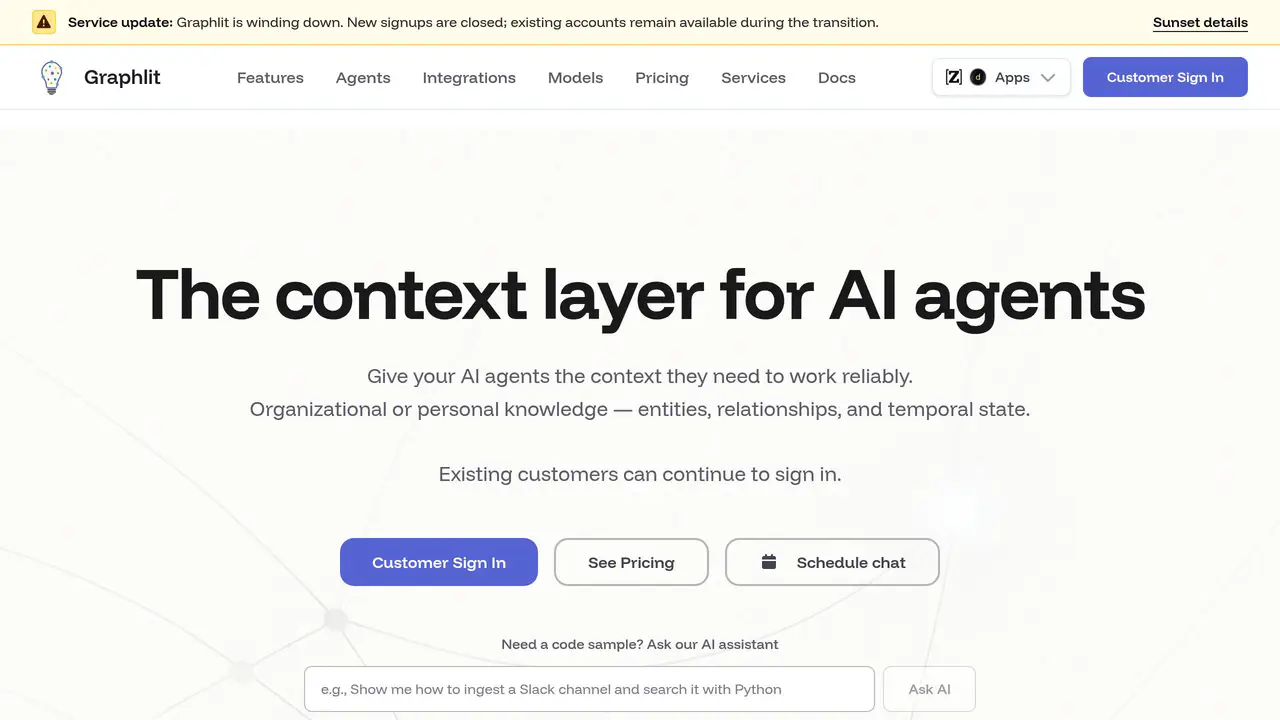
Read-only public captures of Graphlit’s homepage. Screenshots are dated, never live embeds, and open full-screen.
Short answers to the questions buyers and builders commonly ask about Graphlit. Each answer cites the shared ledger below, where every source is listed once.
Organizational memory — entities, relationships, and temporal state · Continuous sync, entity resolution, and provenance in one API · Built-in visual object detection, transcription, and OCR · Semantic infrastructure for AI applications including ingestion, RAG, search, knowledge gr
Organizational memory — entities, relationships, temporal state
AI-powered knowledge management platform for developers
an AI-powered knowledge management platform for developers and related services
Ingest documents, audio, video, and web pages, then extract entities and relationships for · Extract people, organizations, projects, events, facts, and decisions from ingested conten · Build cross-tool RAG, research, and operational intelligence workflows · Agent delivery to Notion via MCP tools with explicit side effects tied to distribution wor
Ingest documents, audio, video, web pages. Extract entities and relationships.
Usage-based pricing with usage-based credit wallet for existing projects · Graphlit Free | $0/month | Limited free usage with content ingestion, content feeds (RSS/W · Graphlit Hobby | $49/month | Paid plan for individual developers · Graphlit Starter | $199/month | Mid-tier paid plan
Usage-based pricing Existing customers can continue to sign in and manage usage-based credits.
Python, Node.js, and .NET SDKs available · Graphlit API exposing createFeed + queryContents endpoints · Graphlit API with createFeed and queryContents endpoints
Python, Node.js, .NET SDKs ready.
32 integrations across 7 categories with 17 delivery targets (Slack, GitHub, GitLab, Jira, · Box integration ingests files and folders via OAuth for enterprise AI search, RAG, and age · Jira via Atlassian OAuth; feed type Issue/AtlassianJira; 1 ingest surface and 1 delivery s · Zoom via zoom OAuth; feed type Meeting/Zoom; ingest only (deliveryEnabled: false)
32 Integrations 17 Delivery targets 7 Categories
This profile connects the jobs Graphlit is described as handling with its delivery model, access options and the subjects used to match it to related products in this directory.
Each fact points to a recorded source, making it easy to distinguish verified product information from claims that need checking.
HTTP 200 verified twice
Graphlit — Context layer for AI agents
Application type is context layer for AI agents · Operated by Unstruk Data, Inc. · AI-powered knowledge management platform for developers
Context layer for AI agents
Organizational memory — entities, relationships, and temporal state
Continuous sync, entity resolution, and provenance in one API
Built-in visual object detection, transcription, and OCR
Ingest documents, audio, video, and web pages, then extract entities and relationships for AI agents
AI-powered knowledge management platform for developers
Usage-based pricing with usage-based credit wallet for existing projects
32 integrations across 7 categories with 17 delivery targets (Slack, GitHub, GitLab, Jira, Linear, Notion, Confluence, Gmail, Outlook, Google/Microsoft Calendar, Google Drive, OneDrive, SharePoint, Dropbox, Box, S3, Azure Blob, HubSpot, Att
Serverless, one API with no infrastructure to deploy
A concise view of the jobs, capabilities and integrations described in the recorded product sources.
Documented product formats, platforms and official distribution destinations. Availability can vary by region and plan.
A concise history of software releases and material product changes. Events appear only when a dated source supports what changed.
Showing the newest updates and meaningful milestones. Open an entry for its summary and source.
Analysis mapping three product shapes sharing the 'company brain' label — agent orchestration platforms, AI-native apps, and context graphs — and arguing that with AI agents as primary users, the underlying data model becomes the source of competitive defensib
View source [21]A 2026 survey of AI agent memory frameworks (Mem0, Supermemory, Graphiti, Zep, LangMem, Cognee, CrewAI, LlamaIndex, Graphlit, and others) arguing the category shifted from vector-store chat history to structured, temporal, scoped, self-editable context systems
View source [19]Surveys 2026 frameworks including Mem0, Supermemory, Membase, Memory Store, Zep, Graphiti, LangMem, Cognee, CrewAI, LlamaIndex, and Graphlit, distinguishing memory APIs and persistence layers from context platforms that retrieve source-grounded operational dat
View source [20]Response to Foundation Capital's thesis and Charles Betz's Forrester critique, arguing that the underlying concepts are a convergence of existing work and that the load-bearing data model — not the category name — creates the long-term moat against incumbents.
View source [18]Facts, answers, structured details, milestones and primary resource links cite this shared ledger. Each external page appears once; release tags from the same GitHub project are grouped under one release history.
These tools share a workflow, capability or audience with Graphlit. They may complement it rather than replace it, and are not presented as integrations or endorsements.
Multitenant-ready with RBAC and encryption at rest
Python, Node.js, and .NET SDKs available
Unstruk Data, Inc. operates Graphlit
Semantic infrastructure for AI applications including ingestion, RAG, search, knowledge graphs, and agent memory
Context layer for AI agents with real-time sync across Slack, GitHub, Jira, and other sources
Built on Microsoft Azure using Azure Cosmos DB, Azure Blob Storage, and Azure AI Search across multiple availability zones
Data in transit encrypted with TLS 1.3 and data at rest encrypted with AES-256
OAuth 2.0 and OpenID Connect protocols with JWT token-based authentication
Graphlit Free | $0/month | Limited free usage with content ingestion, content feeds (RSS/Web/Notion/blob storage), text/vector search, RAG chatbot conversations, configurable workflows, transcription/embeddings/completions, usage-based cred
Graphlit Hobby | $49/month | Paid plan for individual developers
Graphlit Starter | $199/month | Mid-tier paid plan
Graphlit Growth | $999/month | Top-tier paid plan
Open-source MCP (Model Context Protocol) Server available for Claude Desktop, Goose, Cline, Cursor, and Windsurf
Box integration ingests files and folders via OAuth for enterprise AI search, RAG, and agent workflows with entity, observation, fact, and summary extraction
Free tier includes community Discord support
Graphlit
Web
DeveloperApplication
Free Graphlit project available ($0 USD)
Graphlit API exposing createFeed + queryContents endpoints
MCP-native (Model Context Protocol) for agent context and delivery flows
Turns ingested sources into searchable, cited, summarized content with extracted entities, observations, and facts for RAG and agent workflows
Jira via Atlassian OAuth; feed type Issue/AtlassianJira; 1 ingest surface and 1 delivery surface; agents can create, update, or comment on Jira issues
Zoom via zoom OAuth; feed type Meeting/Zoom; ingest only (deliveryEnabled: false)
Slack via Slack OAuth; feed type Slack; 1 ingest surface and 1 delivery surface; agents can post approved channel messages and thread replies via the post_channel_message MCP tool
Gmail via Google OAuth; feed type Email/GoogleEmail; 1 ingest surface and 2 delivery surfaces; agents can send approved follow-up email and create email drafts for human review
Extract people, organizations, projects, events, facts, and decisions from ingested content so agents can reason over reusable context
DeveloperApplication (Web)