
HTTP 200 verified twice
Finding your next stop…
Loading the latest directory information.
Loading the latest directory information.
Start here for the decision-making essentials: what Gradio does, who it is for, how it is accessed, and the first-party sources behind this profile.
Deploying Gradio apps to Hugging Face Spaces is free
Gradio is a Python library for building and sharing interactive web interfaces for machine learning models in minutes. It supports diverse data types, event-driven interactions, and free deployment via Hugging Face Spaces with auto-scaling hosting.
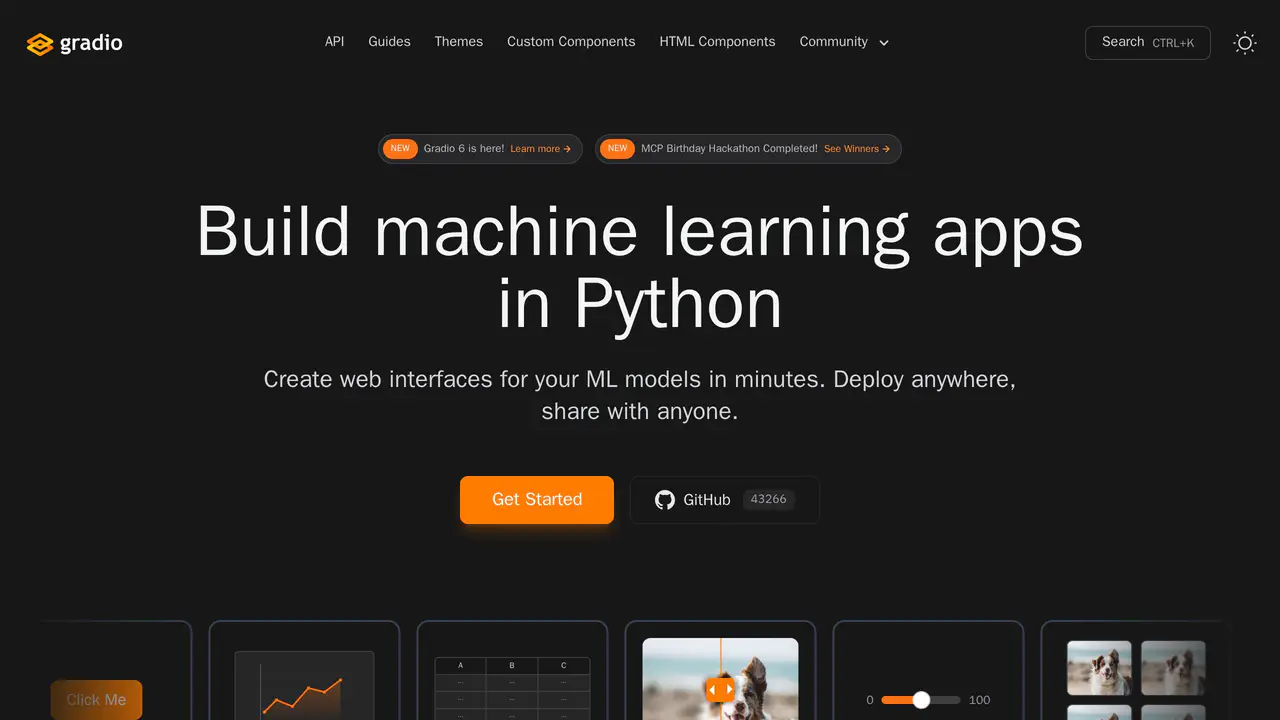
Read-only public captures of Gradio’s homepage. Screenshots are dated, never live embeds, and open full-screen.
Short answers to the questions buyers and builders commonly ask about Gradio. Each answer cites the shared ledger below, where every source is listed once.
Create web interfaces for machine learning models in minutes via a Python library · Supports input and output for Images, Audio, Video, 3D, Dataframes, and more data types · Can create a public shareable link for an ML demo running on a local computer in seconds · 3D model viewer component supports uploading/viewing .obj, .glb, .stl, .gltf, .splat, and
Create web interfaces for your ML models in minutes.
Building ML app prototypes through to production-ready web applications
From prototypes to production-ready web apps.
Deploying Gradio apps to Hugging Face Spaces is free
Deploy to Hugging Face Spaces for free.
Integrates with Hugging Face Spaces for free hosting and sharing of ML demos
Deploy to Hugging Face Spaces for free.
Apps can be deployed to Hugging Face Spaces with always-online, auto-scaling hosting and a
Deploy to Hugging Face Spaces for free. Always online, auto-scaling, and shareable with a simple URL.
Component event functions are exposed as API endpoints with public, private, or undocument
controls the visibility and accessibility of this endpoint. Can be "public" (shown in API docs and callable by clients), "private" (hidden from API docs and not callable by the Gradio client libraries), or "undocumented" (hidden from API docs but callable by clients and via gr.load).
This profile connects the jobs Gradio is described as handling with its delivery model, access options and the subjects used to match it to related products in this directory.
Each fact points to a recorded source, making it easy to distinguish verified product information from claims that need checking.
HTTP 200 verified twice
Gradio
Creates web interfaces for ML models in minutes via a Python library · Supports input/output for Images, Audio, Video, 3D, Dataframes, and more · Can create a public shareable link for an ML demo running on a local computer in seconds
Create web interfaces for machine learning models in minutes via a Python library
Supports input and output for Images, Audio, Video, 3D, Dataframes, and more data types
Can create a public shareable link for an ML demo running on a local computer in seconds
3D model viewer component supports uploading/viewing .obj, .glb, .stl, .gltf, .splat, and .ply files
Supports event listeners (e.g., change, upload, edit, clear) to respond to user interactions in app interfaces
Building ML app prototypes through to production-ready web applications
Apps can be deployed to Hugging Face Spaces with always-online, auto-scaling hosting and a simple shareable URL
Integrates with Hugging Face Spaces for free hosting and sharing of ML demos
Deploying Gradio apps to Hugging Face Spaces is free
A concise view of the jobs, capabilities and integrations described in the recorded product sources.
Documented product formats, platforms and official distribution destinations. Availability can vary by region and plan.
A concise history of software releases and material product changes. Events appear only when a dated source supports what changed.
This profile is being checked for dated releases and material product changes. Nothing appears here until the exact date and event can be verified from a recorded source.
Facts, answers, structured details, milestones and primary resource links cite this shared ledger. Each external page appears once; release tags from the same GitHub project are grouped under one release history.
These tools share a workflow, capability or audience with Gradio. They may complement it rather than replace it, and are not presented as integrations or endorsements.
Distributed as a Python package installable with `pip install gradio`
Web-based interactive machine learning demo and app framework
Open-source Python package · Build web-based GUIs and demos for ML models, APIs, or arbitrary Python functions in a few · Machine learning prototypes, production-ready web apps, chatbot UIs, and custom ML applica
Open-source Python package
Build web-based GUIs and demos for ML models, APIs, or arbitrary Python functions in a few lines of code
Machine learning prototypes, production-ready web apps, chatbot UIs, and custom ML applications
Python library for creating interactive ML web demos and applications
Installable via pip: pip install gradio
Deploy to Hugging Face Spaces for free (always online, auto-scaling, shareable URL) or run locally with public shareable links
Free deployment on Hugging Face Spaces
Supports Images, Audio, Video, 3D, Dataframes and 30+ built-in components; integrates with Hugging Face Spaces
Optional basic authentication via auth=('username', 'password') tuple in launch()
Step-by-step quickstart guide plus full API reference documentation for the Gradio ecosystem
Plot component displays matplotlib, plotly, altair, and bokeh plots
Code component creates a code editor for viewing or entering code with syntax highlighting across many languages
Radio component creates single-selection radio buttons of string or numeric type
Audio component supports file upload and microphone recording as input, and audio playback as output
Component event functions are exposed as API endpoints with public, private, or undocumented visibility
Designed for building interactive machine learning model demos wired to prediction functions
Python library distributed as a pip wheel (gradio-6.26.0)
Apps are run by calling the launch() method on an Interface or Blocks object
Audio component share button shares audio via Hugging Face Spaces Discussions
Source code published on GitHub at gradio-app/gradio
Code component syntax-highlights python, c, cpp, markdown, latex, json, html, css, javascript, typescript, yaml, r, sql dialects and more
Build interactive web UIs around Python functions, including machine learning model prediction functions
Provides reusable UI components such as Button, Slider, Number, Gallery, ClearButton, DeepLinkButton, DuplicateButton, and LoginButton
Attach event listeners (e.g. .click, .change, .input, .submit, .release) to components that trigger user-defined Python functions
Supports batching of inputs so a function can process a list of values per parameter and return a tuple of lists