


HTTP 200 verified twice
Finding your next stop…
Loading the latest directory information.
Loading the latest directory information.
Start here for the decision-making essentials: what Liquid AI does, who it is for, how it is accessed, and the first-party sources behind this profile.
See official pricing
Liquid AI is an efficiency-first foundation model company spun out of MIT, headquartered in Cambridge, Massachusetts. It builds compute-optimized Liquid Foundation Models (LFMs) for on-device, edge, and cloud deployment via its LEAP platform, with open weights on Hugging Face.
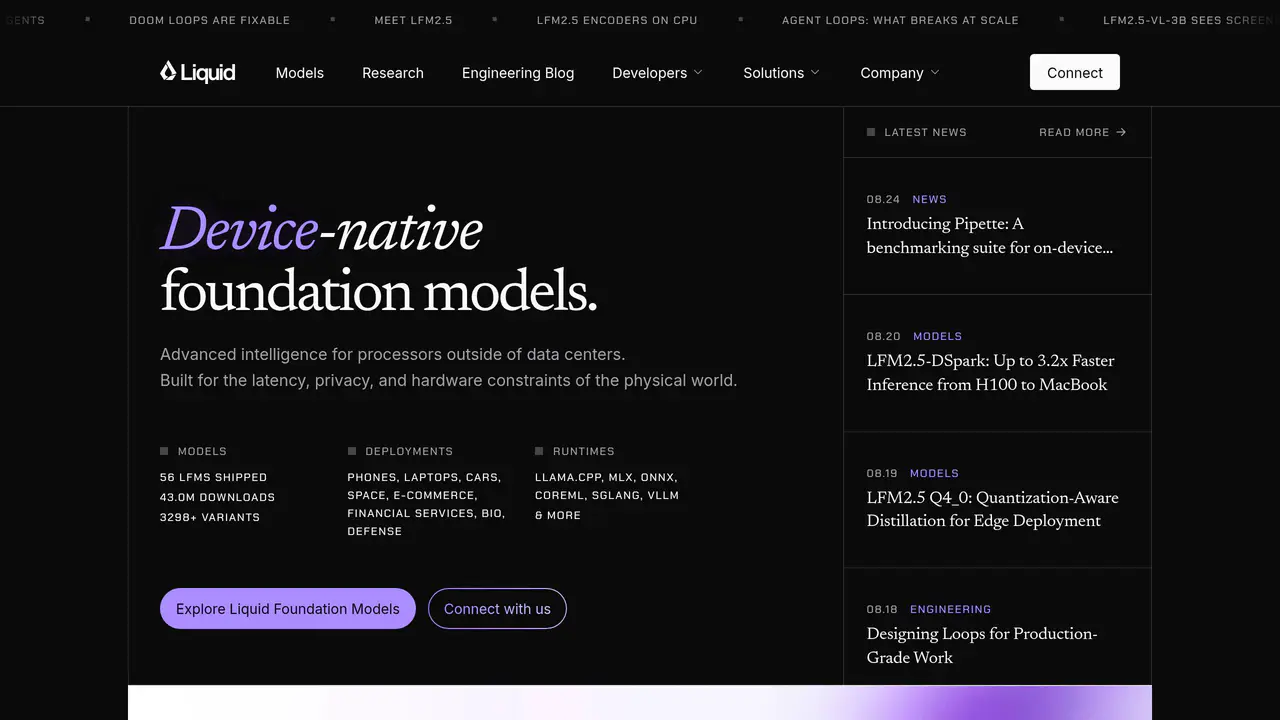
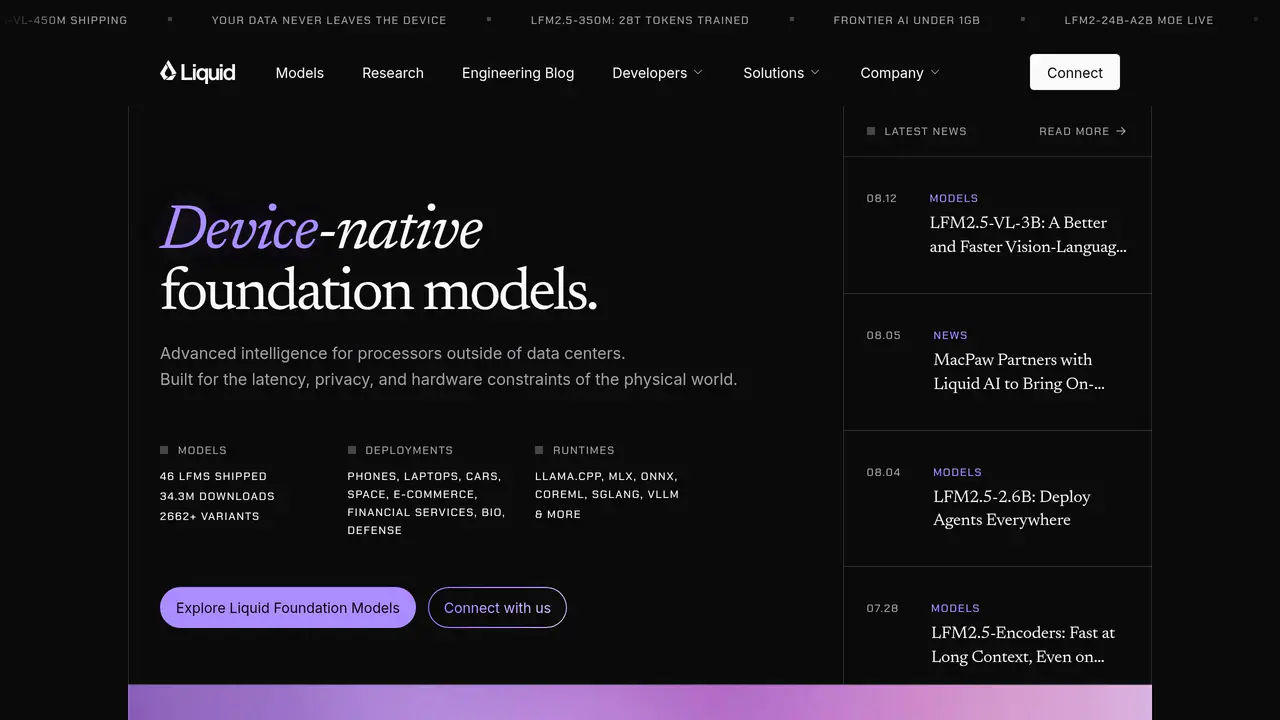
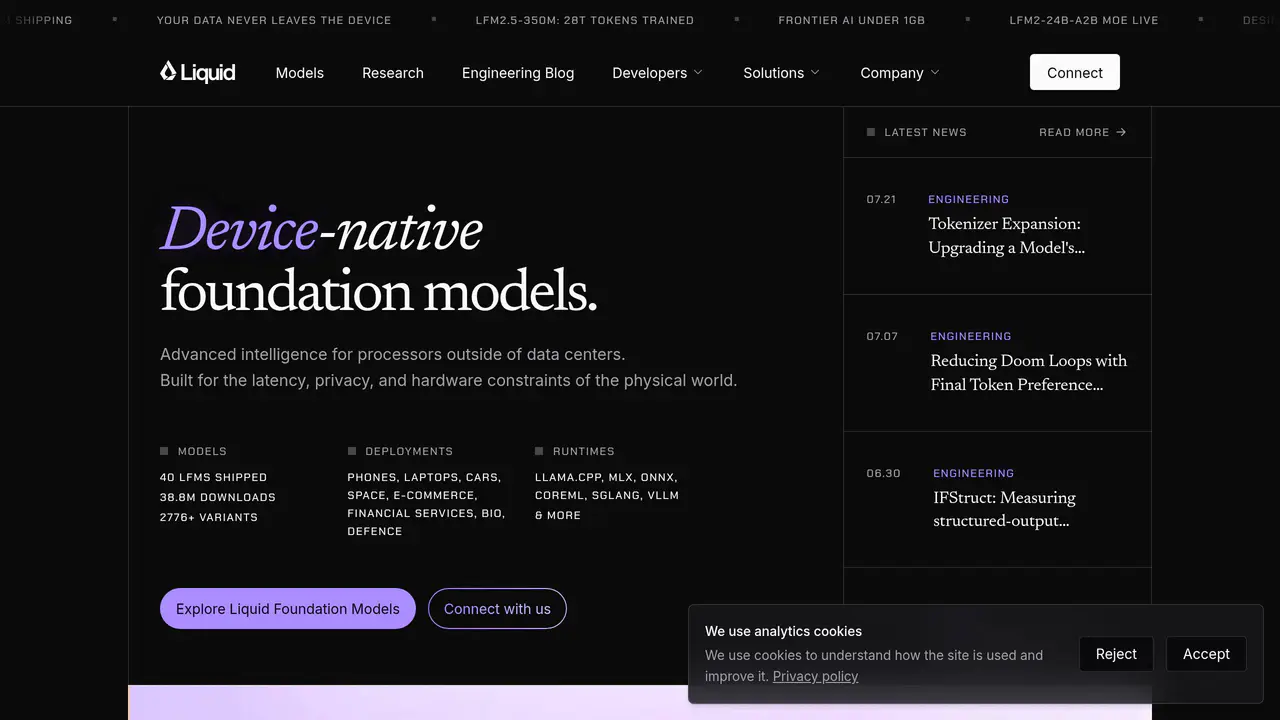
Read-only public captures of Liquid AI’s homepage and verified pricing page. Screenshots are dated, never live embeds, and open full-screen.
Short answers to the questions buyers and builders commonly ask about Liquid AI. Each answer cites the shared ledger below, where every source is listed once.
sub-100ms response times for on-device AI on laptops · Private, on-device generative models
run powerful AI models directly on your users' laptops with sub-100ms response times
Real-time mobile assistants, private enterprise apps, safety-critical systems, and high-vo · Embedded in-car intelligence and MBUX Virtual Assistant for vehicles · Lightweight scientific foundation models for pharmaceutical drug discovery · Edge AI for autonomous navigation of ground and aerial vehicles, customer behavior analysi
Liquid Foundation Models (LFMs) solve for latency, privacy, and cost. That covers real-time mobile assistants, private enterprise apps, safety-critical systems, and high-volume workloads where cloud API pricing doesn't scale.
No first-party hosted API; paid access available via Openrouter and free limited playgroun
We do not currently offer a hosted API of our own. We offer certain models on playground (free with rate limits) and Openrouter (paid with higher limits).
Compatible with llama.cpp, MLX, ONNX, CoreML, SGLang, and vLLM runtimes · Native support for AMD Ryzen and Ryzen AI processors; uses llama.cpp as its inference engi · Integrated with Mercedes-Benz 3rd- and 4th-generation MBUX on the MB.OS software architect
llama.cpp, MLX, ONNX, CoreML, SGLang, vLLM & more
On-device, edge, and cloud deployments with hardware-aware optimization · on-device, edge, and cloud AI deployment · On-device, on-premise, and embedded deployment in resource-constrained environments · Sub-20 millisecond, multimodal, quality-preserving inference on edge devices
Device-native foundation models. Advanced intelligence for processors outside of data centers. Built for the latency, privacy, and hardware constraints of the physical world.
Open weight, not fully open source; weights are publicly available for download, local dep · Every LFM is free to download, run, and fine-tune
They are open weight. This means the model weights are publicly available for download, local deployment, and commercial use. This is different from open source, which would include releasing the full training code, data, and methodology.
This profile connects the jobs Liquid AI is described as handling with its delivery model, access options and the subjects used to match it to related products in this directory.
Each fact points to a recorded source, making it easy to distinguish verified product information from claims that need checking.
HTTP 200 verified twice
Liquid AI | Device-native foundation models.
Efficiency-first foundation model company building compute-optimized models for any device · Spun out of MIT, founded by MIT researchers · Headquartered in Cambridge, Massachusetts
Liquid AI is an efficiency-first foundation model company that builds compute-optimized models for any device and medium of choice.
Liquid Foundation Models (LFMs)
LEAP (Liquid Edge AI Platform) for model selection, customization, evaluation, and on-device testing
Liquid neural networks and state-space models
On-device, edge, and cloud deployments with hardware-aware optimization
Compatible with llama.cpp, MLX, ONNX, CoreML, SGLang, and vLLM runtimes
No first-party hosted API; paid access available via Openrouter and free limited playground
Open weight, not fully open source; weights are publicly available for download, local deployment, and commercial use
Models available for direct download on Hugging Face; customization and deployment via LEAP
A concise view of the jobs, capabilities and integrations described in the recorded product sources.
Documented product formats, platforms and official distribution destinations. Availability can vary by region and plan.
A concise history of software releases and material product changes. Events appear only when a dated source supports what changed.
Showing the newest updates and meaningful milestones. Open an entry for its summary and source.
Released LFM2.5-VL-3B, a 3B-parameter vision-language model in the LFM2.5 line targeting faster edge inference.
View source [1]Released LFM2.5-2.6B, an updated 2.6B-parameter model in the LFM2.5 family positioned for agent workloads at the edge.
View source [1]Released LFM2.5-Encoders, encoder-only LFM2.5 models optimized for long-context embedding and retrieval, including on CPU.
View source [1]Released LFM2.5-230M, a 230M-parameter model in the LFM2.5 line aimed at the lowest-resource edge devices.
View source [1]Released LFM2.5 Retrievers, bi-directional models aimed at fast multilingual search.
View source [1]Facts, answers, structured details, milestones and primary resource links cite this shared ledger. Each external page appears once; release tags from the same GitHub project are grouped under one release history.
These tools share a workflow, capability or audience with Liquid AI. They may complement it rather than replace it, and are not presented as integrations or endorsements.
On-prem LFM customization stack available for purchase to enterprises for fine-tuning within their firewall
Real-time mobile assistants, private enterprise apps, safety-critical systems, and high-volume workloads
Spun out of MIT
Liquid AI is an efficiency-first foundation model company that builds highly capable, compute-optimized models to bring intelligence to any device and medium of choice.
MIT-born
Liquid Foundation Models (LFMs)
LFM2.5-8B-A1B
LFM2-24B-A2B
LFM2.5-1.2B-JP-202606
text, vision, audio, and nano models
on-device, edge, and cloud AI deployment
Every LFM is free to download, run, and fine-tune
Liquid Edge AI Platform (LEAP)
Native support for AMD Ryzen and Ryzen AI processors; uses llama.cpp as its inference engine
Windows, macOS, Linux
sub-100ms response times for on-device AI on laptops
Liquid AI Japan
GitHub: Liquid4All; Hugging Face: LiquidAI; LinkedIn: liquid-ai-inc; X: @liquidai; Discord: discord.com/invite/liquid-ai; YouTube: /channel/UClzRQA8Un3AJnlD6h1hv6fA; Substack: liquidai.substack.com
Efficiency-first foundation model company building highly capable, compute-optimized models
Cambridge, Massachusetts
Build efficient general-purpose AI systems at every scale
Liquid Foundation Models based on dynamical systems and signal processing
Liquid Foundation Models (LFM) / LFM2
LFM2-2.6B-MMAI
2.6B parameters
On-device, on-premise, and embedded deployment in resource-constrained environments
Embedded in-car intelligence and MBUX Virtual Assistant for vehicles
Lightweight scientific foundation models for pharmaceutical drug discovery
Released LFM2.5-VL-450M, a 450M-parameter vision-language model with grounding, better instruction following, and function calling, pre-trained on 28T tokens.
View source [18]Released LFM2.5-350M with additional pre-training (10T to 28T tokens) and reinforcement learning, optimized for tool use, data extraction, and structured outputs at the edge.
View source [17]Released LFM2.5-350M, an updated 350M-parameter model trained on 28T tokens with reinforcement learning, targeting tool use and structured outputs at the edge.
View source [17]Published guidance on running tool-calling agent workloads with LFM2-24B-A2B on consumer hardware, without cloud dependency.
View source [1]Announced a strategic partnership with Insilico Medicine to deliver lightweight scientific foundation models for drug discovery, including LFM2-2.6B-MMAI.
View source [4]Announced a strategic partnership with Insilico Medicine producing LFM2-2.6B-MMAI, a 2.6B-parameter foundation model for drug discovery running on private infrastructure.
View source [4]Released LFM2-24B-A2B, a sparse Mixture-of-Experts model with 24B total and 2B active parameters, designed to fit in 32GB of RAM for cloud and edge deployment.
View source [16]Released LFM2-24B-A2B, a 24B-total/2B-active sparse Mixture-of-Experts model designed to fit in 32GB of RAM and run on cloud or AI PCs.
View source [16]Released LFM2.5-1.2B-Thinking, a 1.2B-parameter reasoning-focused model positioned to run on-device under 1GB of memory.
View source [1]Introduced LFM2.5 as the next generation of on-device AI foundation models.
View source [1]Introduced LFM2.5 as the next generation of Liquid AI's on-device foundation models, succeeding the LFM2 line.
View source [1]Announced a multi-year partnership with Shopify to bring sub-20ms Liquid foundation models into core commerce experiences.
View source [9]Released LFM2-ColBERT-350M, a single embedding model intended for unified retrieval use cases.
View source [1]Released LFM2-VL-3B, a larger 3B-parameter vision-language model in the LFM2-VL family targeted at edge inference.
View source [1]Released LFM2-8B-A1B, an on-device mixture-of-experts model with 8.3B total and ~1.5B active parameters per token.
View source [1]Released LFM2-8B-A1B, an 8.3B-parameter mixture-of-experts model with 1.5B active parameters per token, designed for on-device deployment.
View source [1]Released LFM2-Audio, an end-to-end audio foundation model targeting sub-100ms response latency for on-device speech applications.
View source [1]Released LFM2-2.6B, a 2.6B-parameter dense language model in the LFM2 family, paired with a redesigned training recipe for efficiency.
View source [1]Released the LFM2-VL vision-language model family, adding image understanding to the LFM2 line for edge deployment.
View source [1]Launched LEAP and Liquid Apollo as products providing an on-device AI development platform.
View source [1]Released LEAP and Liquid Apollo as Liquid AI's on-device model platform and runtime stack for deploying foundation models outside data centers.
View source [1]