
Freeper month
$0/month
- first 100,000 runs free, no credit card required
Loading the latest directory information.
Start here for the decision-making essentials: what Hatchet does, who it is for, how it is accessed, and the first-party sources behind this profile.
$0/month
$1,000/month
$0/month
Hatchet is an MIT-licensed open-source platform for orchestrating AI agents, scheduling background tasks, and running mission-critical durable workflows. It offers TypeScript, Python, and Go SDKs, Postgres-backed durable execution, and OpenTelemetry-native observability.
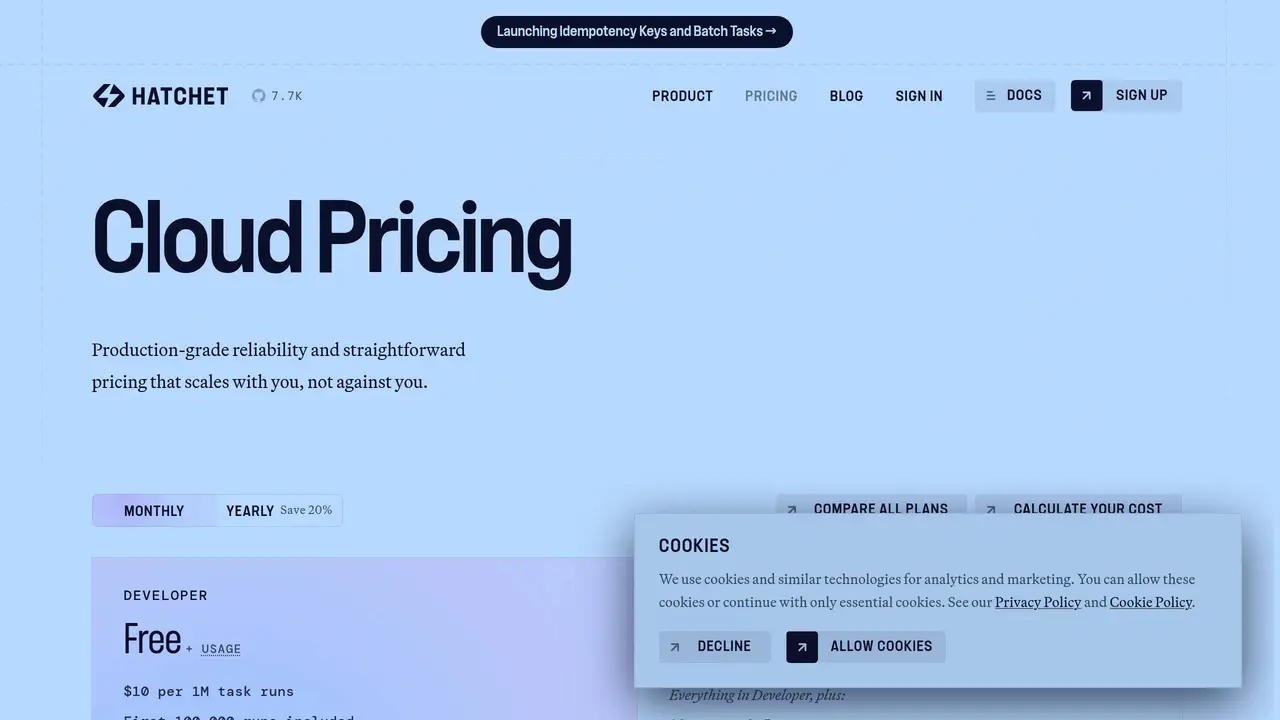
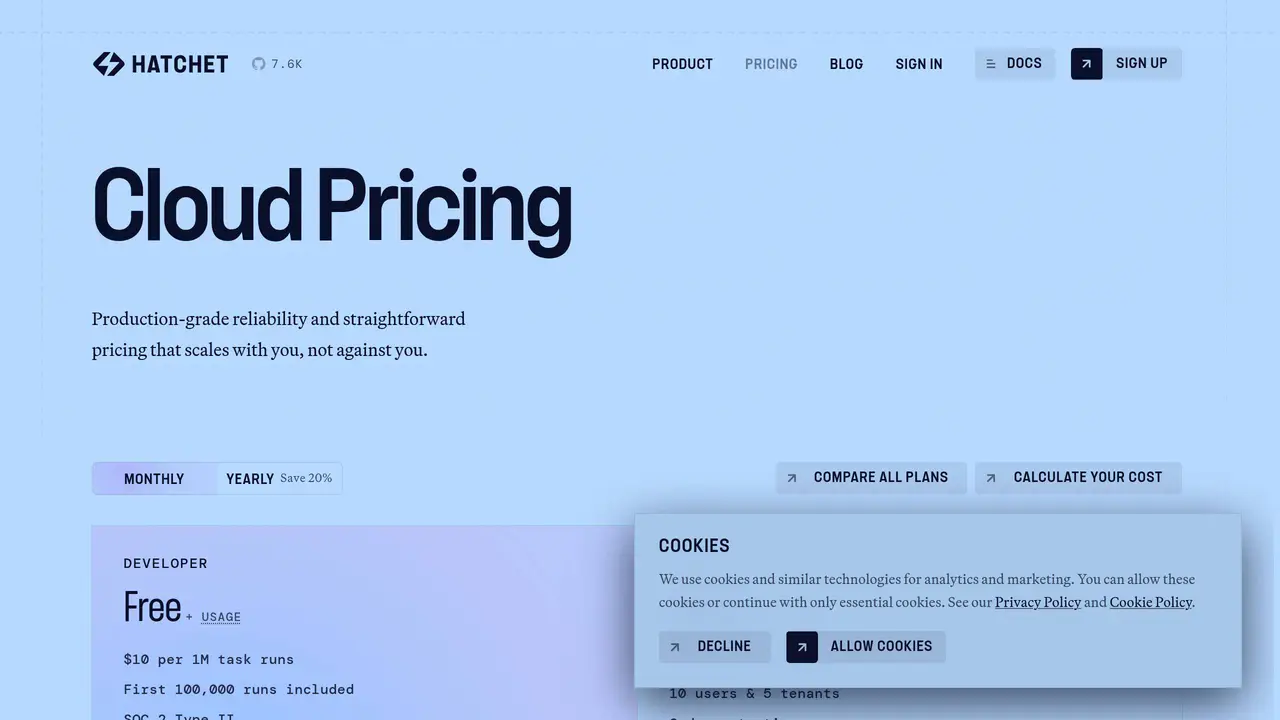
Read-only public captures of Hatchet’s homepage and verified pricing page. Screenshots are dated, never live embeds, and open full-screen.
Short answers to the questions buyers and builders commonly ask about Hatchet. Each answer cites the shared ledger below, where every source is listed once.
Orchestrating AI agents, scheduling background tasks, and running mission-critical workflo · OpenTelemetry tracing and Prometheus metrics for monitoring · Durable execution backed by Postgres, with durable tasks, DAGs, cron jobs, scheduled tasks · Full task run visibility with execution traces, preserved inputs/outputs, logs, metrics, a
Hatchet is a single platform for orchestrating AI agents, scheduling background tasks, and running mission-critical workflows.
Orchestrating AI agents, scheduling background tasks, and running mission-critical workflo
Hatchet is a single platform for orchestrating AI agents, scheduling background tasks, and running mission-critical workflows.
Free | $0/month | first 100,000 runs free, no credit card required · Tier 2 | $1,000/month | 300M+ runs per month, latency guarantees, SSO, audit logging, brin · Free tier on Hatchet Cloud | $0/month | MIT-licensed open source self-hosting
Get started for free today. No credit card required and your first 100,000 runs are on us.
Works with Claude Code, Cursor, and other coding agents · OpenTelemetry-native; forwards traces to Datadog, Grafana, Honeycomb, or any OTEL-compatib
Integrates with your coding agents Works with Claude Code, Cursor, and more.
Self-hostable; runs on Kubernetes, Docker, or other container-based platforms · Workers run as standard long-lived processes and deploy on the container platform already
Runs anywhere containers run Run Hatchet on Kubernetes, Docker, or other container-based platforms.
Enterprise-grade security, compliance, and SSO
Enterprise-grade security, compliance, and SSO
This profile connects the jobs Hatchet is described as handling with its delivery model, access options and the subjects used to match it to related products in this directory.
Each fact points to a recorded source, making it easy to distinguish verified product information from claims that need checking.
HTTP 200 verified twice
Hatchet | The orchestration engine for teams who ship
Hatchet is a single platform for orchestrating AI agents, scheduling background tasks, and · Hatchet Technologies, Inc. is the legal entity · Native SDKs across TypeScript, Python, and Go
Orchestrating AI agents, scheduling background tasks, and running mission-critical workflows
Hatchet Technologies, Inc.
TypeScript, Python, and Go SDKs
MIT-licensed open source
Self-hostable; runs on Kubernetes, Docker, or other container-based platforms
Global deployments across the US and EU
Works with Claude Code, Cursor, and other coding agents
OpenTelemetry tracing and Prometheus metrics for monitoring
Durable execution backed by Postgres, with durable tasks, DAGs, cron jobs, scheduled tasks, event triggers, webhook triggers, retries, priorities, rate limits, fair scheduling, and worker slots
A concise view of the jobs, capabilities and integrations described in the recorded product sources.
Documented product formats, platforms and official distribution destinations. Availability can vary by region and plan.
A concise history of software releases and material product changes. Events appear only when a dated source supports what changed.
Showing the newest updates and meaningful milestones. Open an entry for its summary and source.
Co-founder Alexander Belanger describes Hatchet's selective adoption of hardcore DevOps principles, drawing on the andon cord concept from Toyota's manufacturing culture to encourage pausing production when defects or bottlenecks arise.
View source [7]Co-founder Alexander Belanger describes Hatchet's selective adoption of the andon cord DevOps practice from Toyota manufacturing, under which any employee can halt production to address bottlenecks.
View source [7]Facts, answers, structured details, milestones and primary resource links cite this shared ledger. Each external page appears once; release tags from the same GitHub project are grouped under one release history.
These tools share a workflow, capability or audience with Hatchet. They may complement it rather than replace it, and are not presented as integrations or endorsements.
Free | $0/month | first 100,000 runs free, no credit card required
Tier 2 | $1,000/month | 300M+ runs per month, latency guarantees, SSO, audit logging, bring your own cloud, self-host support, custom SLAs & uptime guarantees, dedicated support & onboarding
Full task run visibility with execution traces, preserved inputs/outputs, logs, metrics, and alerting
Durable execution engine that checkpoints every task so machine crashes and restarts do not lose work
Tasks can sleep for days or wait for external events without burning compute, then resume from last checkpoint
Replay any failed run directly from the UI with one click
OpenTelemetry-native; forwards traces to Datadog, Grafana, Honeycomb, or any OTEL-compatible backend
Workers run as standard long-lived processes and deploy on the container platform already used
Open-source and self-hostable
MIT-licensed open source
Free tier on Hatchet Cloud | $0/month | MIT-licensed open source self-hosting
Enterprise-grade security, compliance, and SSO
Orchestrating AI agents, scheduling background tasks, and running mission-critical workflows
Hatchet Technologies, Inc.
A single platform for orchestrating AI agents, scheduling background tasks, and running mi · The orchestration engine for teams who ship · Start for free (Free tier available)
Teams who ship
Free tier available (Start for free)
Background tasks defined as simple functions
Retries with flexible and configurable policies such as exponential backoff
Scheduled tasks for a specific time in the future
Cron jobs for running tasks on a regular schedule
Task routing based on worker labels or weighted scheduling rules using worker affinity
Event triggers and listeners for event-driven distributed systems
Webhook triggers for Hatchet tasks from upstream data sources
Durable tasks for fault-tolerant, long-running workflows that can recover from failure
Enterprise: custom pricing via Let's Talk
Python, TypeScript, and Go SDKs
Typed workflow definitions with full generic support