

HTTP 200 verified twice
Finding your next stop…
Loading the latest directory information.
Loading the latest directory information.
Start here for the decision-making essentials: what DuckDB does, who it is for, how it is accessed, and the first-party sources behind this profile.
Free / $0 USD
DuckDB is an in-process SQL OLAP database management system. Simple, feature-rich, fast & open source.
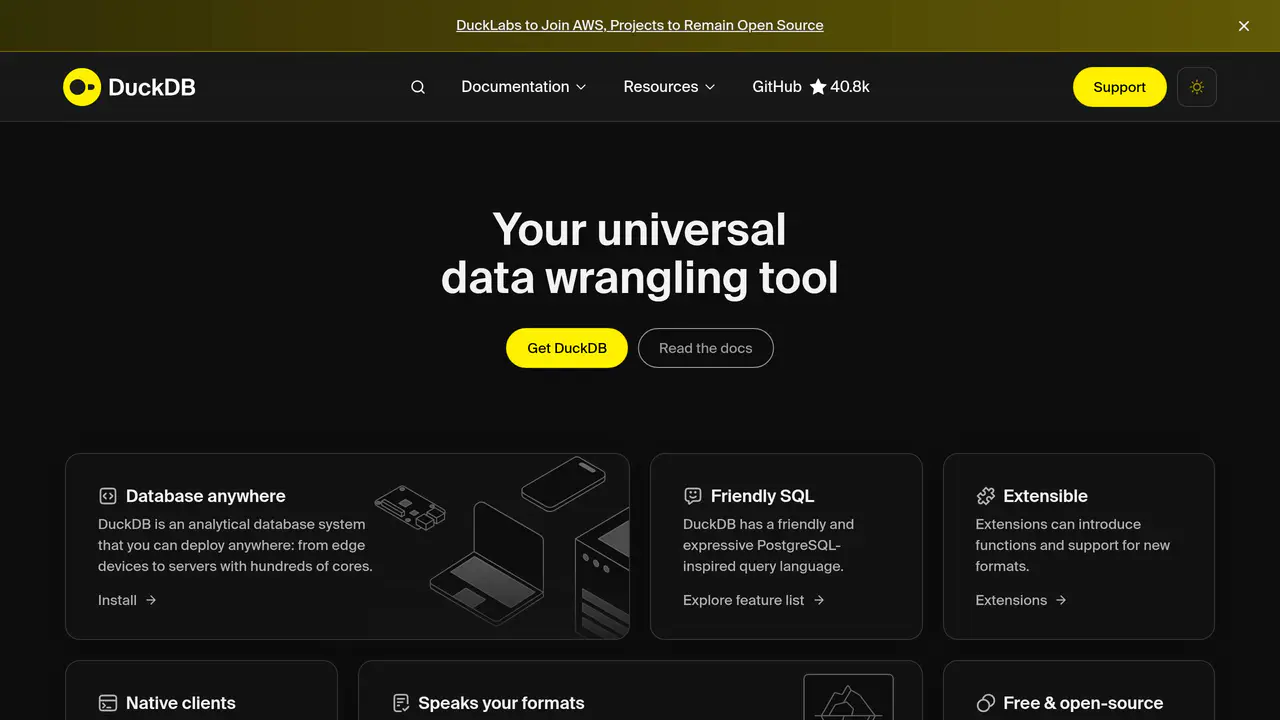
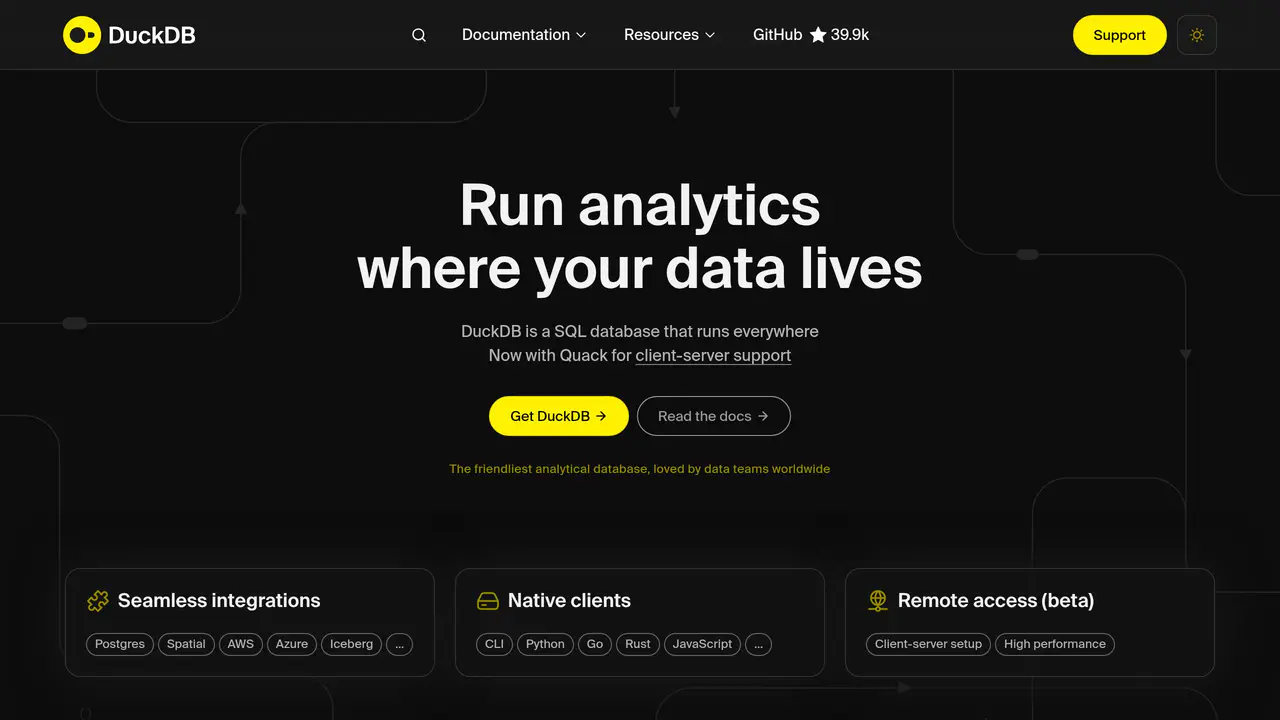
Read-only public captures of DuckDB’s homepage. Screenshots are dated, never live embeds, and open full-screen.
Short answers to the questions buyers and builders commonly ask about DuckDB. Each answer cites the shared ledger below, where every source is listed once.
SQL OLAP database management system designed for analytical workloads · Client APIs for C, C++, CLI, Go, Java (JDBC), Node.js, ODBC, Python, R, Rust, and WebAssem · Directly queries CSV, JSON, and Parquet files by filename without prior loading · Appender available in C, C++, Go, Java, and Rust APIs for bulk data loading
DuckDB is a SQL OLAP database management system.
Data scientists and data engineers
DuckDB was designed with both data science and data engineering workloads in mind.
Interactive data analysis (data science), automated data processing pipelines (data engine
DuckDB's use cases can be split into roughly three major categories. Namely, DuckDB can be used for interactive data analysis by a user ("data science") and as pipeline component for automated data processing ("data engineering"). DuckDB can also be deployed in novel architectures, where one traditionally couldn't run an analytical database management system but DuckDB is available thanks to its portability. These ar
Single-node database system using vertical scalability only (more CPU, memory, disk on one · Quack is in beta and under active development; protocol, function names, settings, and def · DuckDB's C++ API is internal, not guaranteed to be stable, and can change without notice;
DuckDB is a single-node database system, hence it makes use of vertical scalability, i.e., making use of more resources (CPU, memory, and disk) to support larger datasets. DuckDB has been tested on machines with 100+ CPU cores and terabytes of memory.
Free / $0 USD
"offers":{"@type":"Offer","price":"0","priceCurrency":"USD"
client APIs for C, CLI, Java (JDBC), Go, Node.js (node-neo), ODBC, Python, R, Rust, WebAss · Go client (duckdb-go) supports the database/sql interface and the DuckDB Appender API for · DuckDB provides a C++ API (header duckdb.hpp), version 1.5.5, downloadable as libduckdb
DuckDB is an in-process database system and offers client APIs ("drivers") for several languages.
This profile connects the jobs DuckDB is described as handling with its delivery model, access options and the subjects used to match it to related products in this directory.
Each fact points to a recorded source, making it easy to distinguish verified product information from claims that need checking.
HTTP 200 verified twice
An analytical SQL database management system
DuckDB is a SQL OLAP database management system · DuckDB is an in-process database system · DuckDB is a relational database management system (RDBMS)
SQL OLAP database management system designed for analytical workloads
MIT license (perpetually open source, no enterprise edition)
Free / $0 USD
Windows, macOS, Linux
Deployable from edge devices up to servers with hundreds of cores, running in-process within applications or as a standalone binary
Client APIs for C, C++, CLI, Go, Java (JDBC), Node.js, ODBC, Python, R, Rust, and WebAssembly
Quack client-server protocol (in beta as of v1.5.2, targeted for maturity with v2.0 in fall 2026)
Interactive data analysis (data science), automated data processing pipelines (data engineering), and embedded deployment in browsers/smartphones; extensions enable geospatial analysis and integration with other database systems
Data scientists and data engineers
A concise view of the jobs, capabilities and integrations described in the recorded product sources.
Documented product formats, platforms and official distribution destinations. Availability can vary by region and plan.
A concise history of software releases and material product changes. Events appear only when a dated source supports what changed.
Showing the newest updates and meaningful milestones. Open an entry for its summary and source.
DuckDB Labs updated the H2O.ai db-benchmark results on a c6id.metal AWS EC2 instance for improved repeatability and fairness; DuckDB was the fastest library for both join and group-by queries at almost every data size.
View source [15]Facts, answers, structured details, milestones and primary resource links cite this shared ledger. Each external page appears once; release tags from the same GitHub project are grouped under one release history.
These tools share a workflow, capability or audience with DuckDB. They may complement it rather than replace it, and are not presented as integrations or endorsements.
Created by Dr. Mark Raasveldt and Dr. Hannes Mühleisen at the Centrum Wiskunde & Informatica (CWI) in Amsterdam, the Netherlands
Single-node database system using vertical scalability only (more CPU, memory, disk on one machine); horizontal distribution not supported natively
Client APIs for C, C++, CLI, Go, Java (JDBC), Node.js, ODBC, Python, R, Rust, and WebAssembly
Directly queries CSV, JSON, and Parquet files by filename without prior loading
Appender available in C, C++, Go, Java, and Rust APIs for bulk data loading
Quack remote protocol: HTTP/HTTPS-based with default port 9494 and quack: URI scheme
Token-based authentication for Quack, with HTTP used for local URIs and HTTPS for remote URIs by default
Official Docker container available
Java JDBC client supports deployment as a native image
Python client integrates with Ibis, Polars, and PyTorch
R client provides a dplyr-compatible API via the duckplyr package
Quack remote protocol released May 12, 2026 as beta in DuckDB v1.5.3
Quack is in beta and under active development; protocol, function names, settings, and defaults subject to change
in-process database system
relational database management system (RDBMS)
MIT
open-source
client APIs for C, CLI, Java (JDBC), Go, Node.js (node-neo), ODBC, Python, R, Rust, WebAssembly (Wasm), ADBC (Arrow), C# (.NET), and C++
Go client (duckdb-go) supports the database/sql interface and the DuckDB Appender API for bulk inserts
Directly queries MySQL, PostgreSQL, and SQLite databases
SQL with a PostgreSQL-compatible dialect
three support tiers: Primary (community-supported, first to receive features), Secondary (receive features, no community support), and Tertiary (no feature or support guarantees)
DuckDB Docker Container
DuckDB provides a C++ API (header duckdb.hpp), version 1.5.5, downloadable as libduckdb
DuckDB's C++ API is internal, not guaranteed to be stable, and can change without notice; the C API is recommended for building applications
DuckDB supports in-memory databases by passing nullptr to the DuckDB constructor
DuckDB supports prepared statements via the Prepare() method on a Connection
DuckDB supports user-defined scalar and vectorized functions through CreateScalarFunction() and CreateVectorizedFunction()