




HTTP 200 verified twice
Finding your next stop…
Loading the latest directory information.
Loading the latest directory information.
Start with the essentials: Code.org’s public mission, organization type, programs and the recorded sources behind this profile.
Education innovation nonprofit
Code.org is a 501(c)(3) education innovation nonprofit founded in 2013 in Seattle, dedicated to expanding free K-12 computer science and AI education with a focus on young women and underrepresented students. It delivers free curriculum and the global Hour of Code campaign.
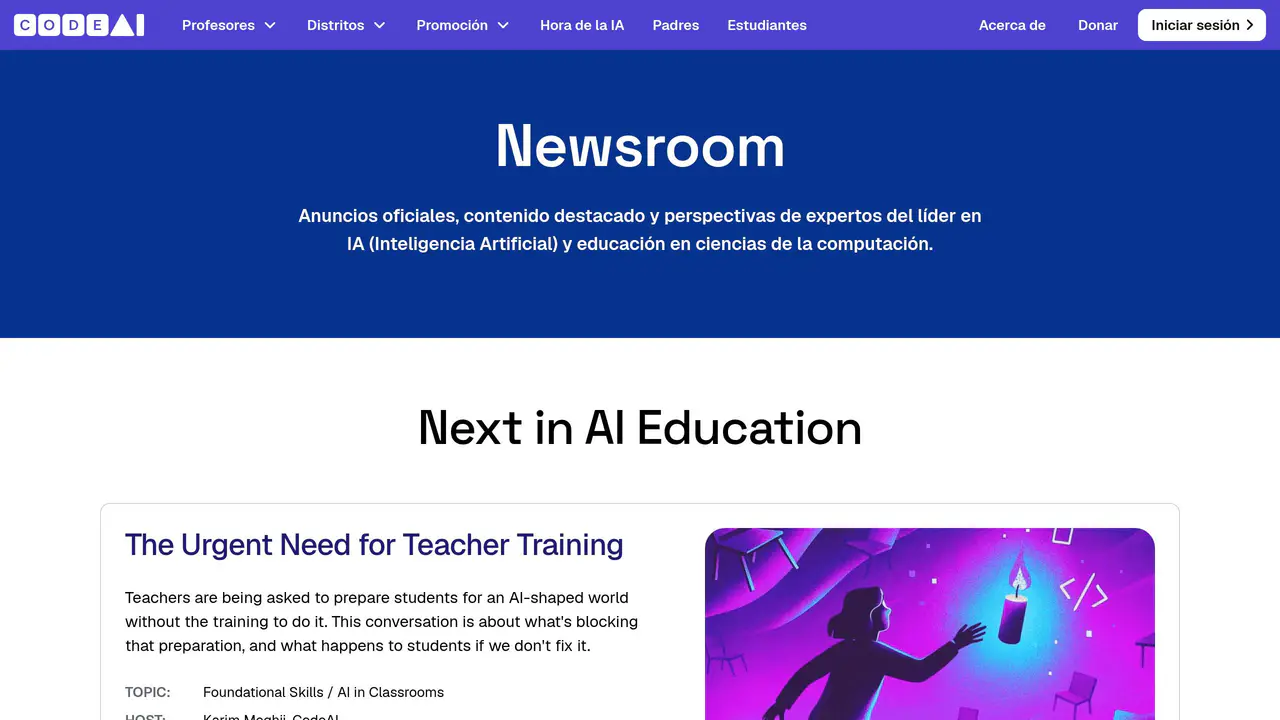
Read-only public captures of Code.org’s homepage and verified pricing page. Screenshots are dated, never live embeds, and open full-screen.
Nonprofit profiles focus on the public information that helps readers understand an organization's role: mission, governance, funding context, programs and reporting.
Short answers to the questions buyers and builders commonly ask about Code.org. Each answer cites the shared ledger below, where every source is listed once.
K-12 students and teachers, with emphasis on young women and students from underrepresente
The leading provider of K-12 computer science curriculum in the largest school districts in the United States
Free K-12 computer science and AI classroom curriculum with hands-on projects, detailed le
Detailed lesson plans and an embedded AI Teaching Assistant mean every teacher can deliver it confidently.
CS Discoveries, CS Principles, CS A, and Intro to App Lab courses require a full keyboard · CS Discoveries, CS Principles, CS A, and Intro to App Lab courses are not compatible with · All CS Discoveries, CS Principles, CS A, and Intro to App Lab courses are not compatible w
All CS Discoveries, CS Principles, CS A, and Intro to App Lab courses are not compatible with tablets or mobile devices - a full keyboard and mouse (or touchpad) are required.
Email support at support@code.org · Help center contact via email support@code.org and support portal at https://support.code. · Help center contact via support@code.org (https://support.code.org/hc/requests/new)
you can email us at support@code.org
Education innovation nonprofit · EducationalOrganization
Code.org® is an education innovation nonprofit dedicated to the vision that every student in every school has the opportunity to learn computer science and artificial intelligence as part of their core K-12 education.
Every student in every school has the opportunity to learn computer science and artificial · Ensure every student in every school has the opportunity to learn computer science and art · Education innovation nonprofit dedicated to the vision that every student in every school
We expand access to and participation in computer science in schools, with a focus on increasing participation by young women and students from other underrepresented groups.
This profile connects the jobs Code.org is described as handling with its delivery model, access options and the subjects used to match it to related products in this directory.
Each fact points to a recorded source, making it easy to distinguish verified product information from claims that need checking.
HTTP 200 verified twice
Free K–12 Curriculum for Digital Fluency | CodeAI
Founded in 2013 · Headquartered in Seattle, Washington, US · 501(c)(3) nonprofit, Tax ID 46-0858543
Education innovation nonprofit
Nonprofit501c3 (Tax ID 46-0858543)
Every student in every school has the opportunity to learn computer science and artificial intelligence as part of their core K-12 education, with a focus on increasing participation by young women and students from other underrepresented g
2013
Seattle, WA, US
Code.org (Code Dot Org); founded by Hadi Partovi (CEO) and Ali Partovi (Co-Founder)
Free K-12 computer science and AI (CodeAI) curriculum, including AI Foundations full-year high school pathway, CS Discoveries, CS Principles, CS A, Intro to App Lab, Computer Science Fundamentals (K-5), and the annual Hour of Code campaign.
K-12 students and teachers, with emphasis on young women and students from underrepresented groups; leading provider in the largest US school districts.
A concise view of the jobs, capabilities and integrations described in the recorded product sources.
Documented product formats, platforms and official distribution destinations. Availability can vary by region and plan.
A concise history of launches, product changes and company milestones. Events appear only when a dated source supports what changed.
Showing the newest updates and meaningful milestones. Open an entry for its summary and source.
CodeAI won four Educators Pick awards out of six nominations in the new "Best of AI" category of the 2026 Best of STEM Awards, judged on safe and ethical classroom AI use.
View source [31]CodeAI announced a partnership with OpenAI to give students and educators tools and resources to learn how to use and benefit from AI responsibly, addressing the gap between AI use and understanding.
View source [32]Code.org rebranded to CodeAI, expanding its mission from computer science into the full digital fluency students need to navigate a world reshaped by AI.
View source [7]Two new free K-12 courses, AI Discoveries and AI Foundations: Designing and Building with AI, enter classrooms to extend the AI education pathway from literacy to building with AI.
View source [7]CodeAI launches two new free K–12 AI courses, AI Discoveries and AI Foundations: Designing and Building with AI, giving every student a path from AI literacy to building with AI.
View source [7]Facts, answers, structured details, milestones and primary resource links cite this shared ledger. Each external page appears once; release tags from the same GitHub project are grouped under one release history.
These tools share a workflow, capability or audience with Code.org. They may complement it rather than replace it, and are not presented as integrations or endorsements.
Largest school districts in the United States; Hour of Code campaign has engaged more than 15% of all students in the world.
Supported by generous donors including Microsoft, Amazon, Google, and many others.
Free K-12 computer science and AI classroom curriculum with hands-on projects, detailed lesson plans, and an embedded AI Teaching Assistant for teachers.
CS Discoveries, CS Principles, CS A, and Intro to App Lab courses require a full keyboard and mouse (or touchpad) and are not compatible with tablets or mobile devices; CS Discoveries, CS Principles, and Intro to App Lab are not usable on m
Education innovation nonprofit
501(c)(3) nonprofit (Tax ID 46-0858543)
Ensure every student in every school has the opportunity to learn computer science and artificial intelligence as part of their core K-12 education, with a focus on increasing participation by young women and students from other underrepres
2013
Seattle, Washington, United States
Code.org, founded by Hadi Partovi (CEO) and Ali Partovi (Co-Founder)
Annual Hour of Code campaign and K-12 computer science curriculum (K-5 CS Fundamentals, CS Discoveries, CS Principles, CS A, Intro to App Lab)
Global; Hour of Code has engaged more than 15% of all students in the world
Supported by generous donors including Microsoft, Amazon, and Google
Email support at support@code.org
CS Discoveries, CS Principles, CS A, and Intro to App Lab courses are not compatible with tablets or mobile devices — a full keyboard and mouse (or touchpad) are required
501(c)(3) nonprofit, tax ID 46-0858543
2013
Seattle, WA, United States
Help center contact via email support@code.org and support portal at https://support.code.org/hc/requests/new
Official profiles on Facebook, X (@codeorg), Instagram, Medium, YouTube, LinkedIn, Wikipedia, and GitHub (code-dot-org)
Code.org (alternate name: Code Dot Org)
EducationalOrganization
Nonprofit501c3; Tax ID 46-0858543
Education innovation nonprofit dedicated to the vision that every student in every school has the opportunity to learn computer science and artificial intelligence as part of their core K-12 education, with a focus on increasing participati
2013
Seattle, Washington, US
Supported by generous donors including Microsoft, Amazon, Google and many others.
Organizes the annual Hour of Code campaign, which has engaged more than 15% of all students in the world.
Leading provider of K-12 computer science curriculum in the largest school districts in the United States.