
Freeper month
$0/month
- 2 hours of processed audio per month with Auphonic jingle included
Loading the latest directory information.
Start here for the decision-making essentials: what Auphonic does, who it is for, how it is accessed, and the first-party sources behind this profile.
$0/month
Auphonic is a cloud-based automatic audio post-production webservice offering intelligent algorithms for loudness normalization, noise reduction, speech recognition, and multitrack processing. It serves podcasters, broadcasters, and audio/video creators with browser, API, and CLI access plus automated publishing workflows.
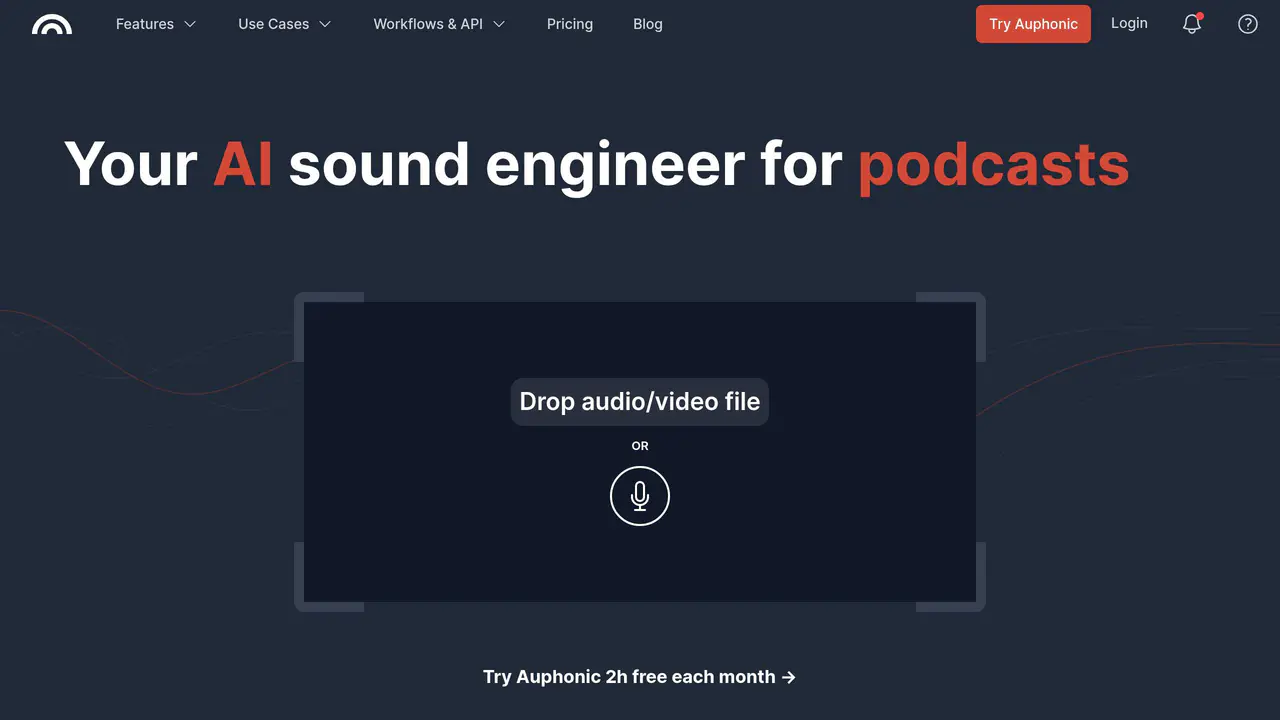
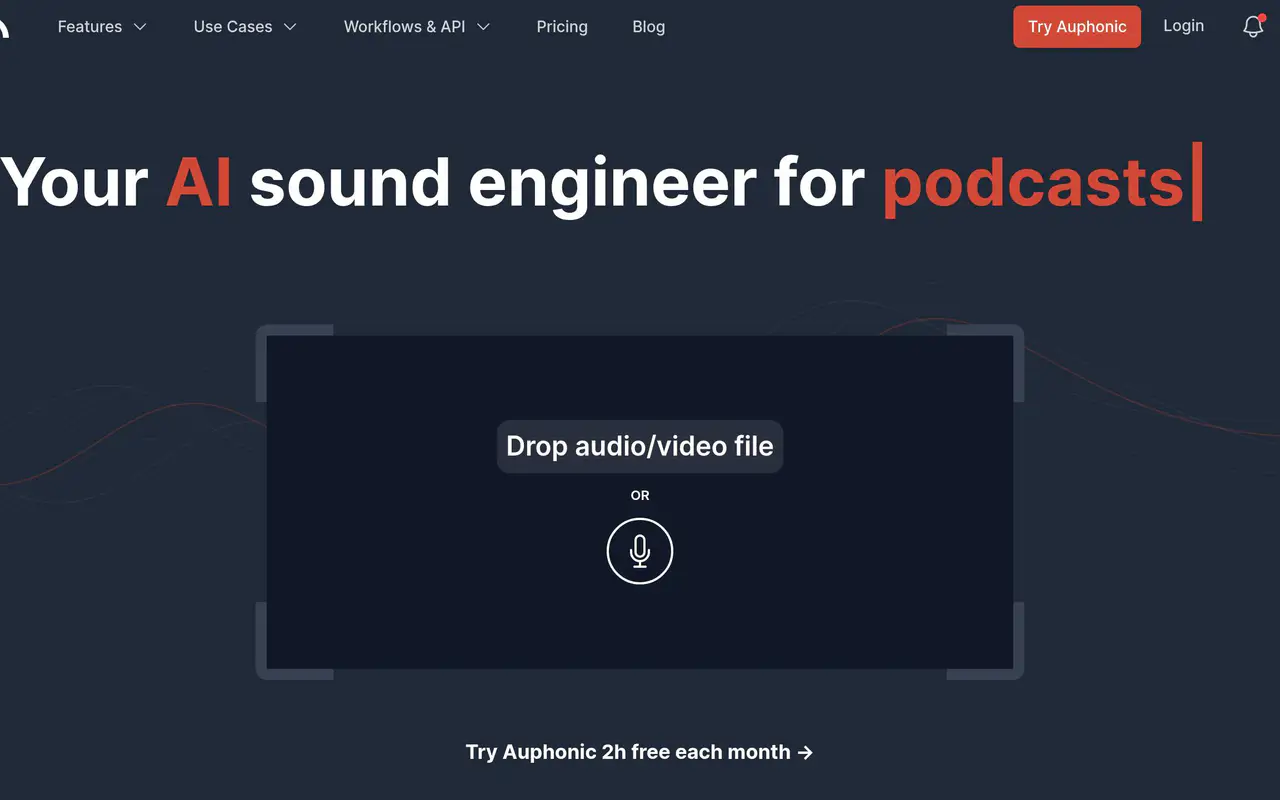
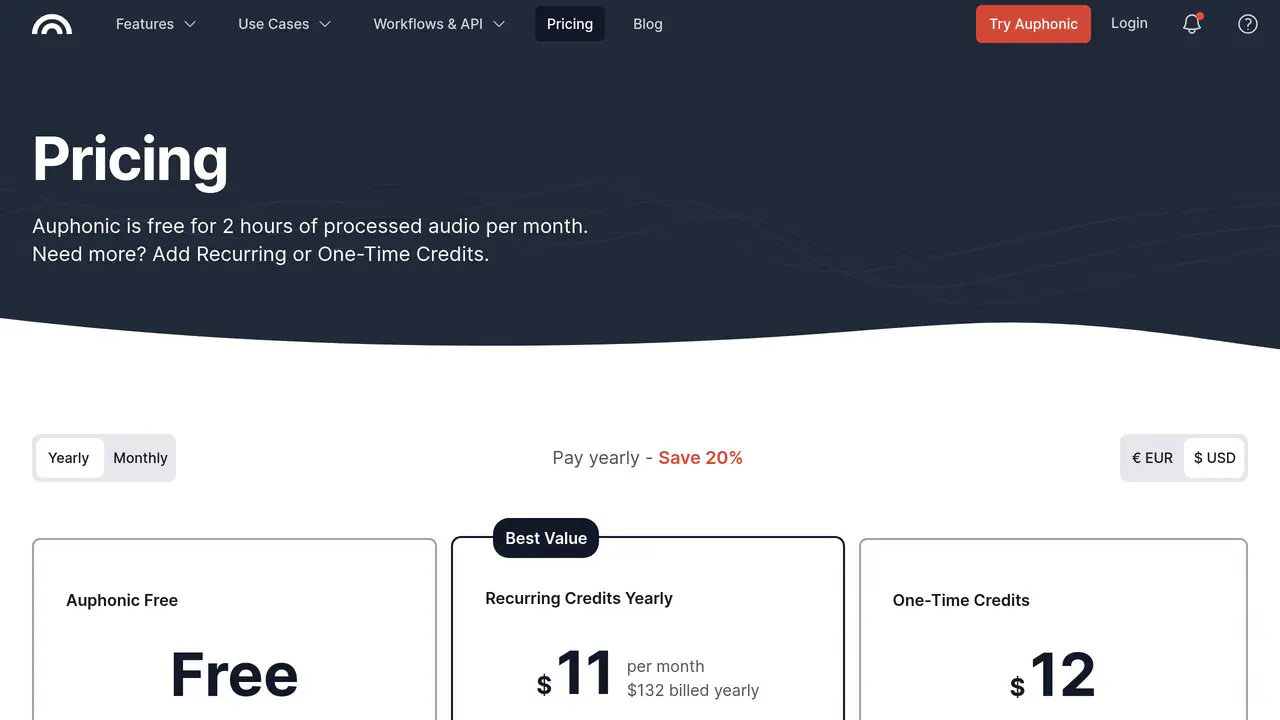
Read-only public captures of Auphonic’s homepage and verified pricing page. Screenshots are dated, never live embeds, and open full-screen.
Short answers to the questions buyers and builders commonly ask about Auphonic. Each answer cites the shared ledger below, where every source is listed once.
intelligent algorithms for loudness normalization, leveling, noise reduction, filtering, a · multilingual speech recognition (paid plans only) · automatic shownotes and chapters generation (paid plans only) · AI noise and reverb reduction with static or adaptive modes and music/breath preservation
It analyzes and processes your audio and video content with intelligent algorithms for loudness normalization, leveling, noise reduction, filtering, speech recognition and more.
post-production and automatic publishing of audio and video content to multiple platforms · Podcasts, radio, broadcast, lecture and conference recordings, film and videos, screencast · File-based audio workflows for broadcasters, podcasters, and teams producing single episod · Burned-in captions for social media videos that autoplay muted, where most platforms don't
Results can be encoded to multiple formats and published to various platforms automatically.
Batch productions and watch folders for workflow automation are restricted to premium user · Processing time averages about 5% of the audio file length (e.g., ~3 minutes for a one-hou · Speech recognition is only available for paying users · Production length limit was increased from 6.5 hours to 10 hours; audio files are only sto
Yes, certain features like batch productions or watch folders for workflow automation are only available for premium users.
Free tier: 2 hours of processed audio per month (includes Auphonic jingle) · Recurring monthly credit plans: S 9 h/m, M 21 h/m, L 45 h/m, XL 100 h/m, XXL 250 h/m · Free tier: up to 2 hours of audio per month (free productions include a jingle); premium f
Auphonic is free for 2 hours of processed audio per month.
Developer API available for custom integrations and applications · Auphonic API with a full OpenAPI 3.0.3 specification covering all endpoints, browsable via · REST API supports burn-in subtitles via a burn_in_subtitles object on video output files;
Yes, our software has a developer API available. The API allows you to build custom integrations and applications that can interact with the software.
Zapier interface for automating podcast workflows with hundreds of web services · Watch folders for automatic productions triggered by new files in Dropbox, Google Drive, o · Zapier interface for no-code automation connecting hundreds of web services · Incoming/outgoing file transfers via FTP, SFTP, Dropbox, Google Drive, OneDrive, Amazon S3
Also take a look at Watch Folders and our Zapier Interface, which helps in automating podcast workflows and integrates hundreds of web services without any coding.
This profile connects the jobs Auphonic is described as handling with its delivery model, access options and the subjects used to match it to related products in this directory.
Each fact points to a recorded source, making it easy to distinguish verified product information from claims that need checking.
HTTP 200 verified twice
What our Customers say about us
application_type: automatic audio post production webservice · capability: intelligent algorithms for loudness normalization, leveling, noise reduction, · capability: multilingual speech recognition and automatic shownotes/chapters on paid plans
automatic audio post production webservice
intelligent algorithms for loudness normalization, leveling, noise reduction, filtering, and speech recognition
multilingual speech recognition (paid plans only)
automatic shownotes and chapters generation (paid plans only)
post-production and automatic publishing of audio and video content to multiple platforms
cloud-based web service accessible via browser, API, and CLI
Free tier: 2 hours of processed audio per month (includes Auphonic jingle)
Recurring monthly credit plans: S 9 h/m, M 21 h/m, L 45 h/m, XL 100 h/m, XXL 250 h/m
Zapier interface for automating podcast workflows with hundreds of web services
A concise view of the jobs, capabilities and integrations described in the recorded product sources.
Documented product formats, platforms and official distribution destinations. Availability can vary by region and plan.
A concise history of software releases and material product changes. Events appear only when a dated source supports what changed.
Showing the newest updates and meaningful milestones. Open an entry for its summary and source.
Auphonic can render styled, timed speech-recognition captions directly into video outputs, including cover-image and Audiogram videos, without exporting separate SRT or VTT files.
View source [9]Auphonic now renders its ASR transcripts as styled, burned-in captions on video outputs (including audio-only cover videos and Audiograms), eliminating the need to export separate SRT/VTT subtitle files.
View source [9]Auphonic can now bake the transcript from its Automatic Speech Recognition as styled, timed captions directly into any video output, including cover-image and Audiogram videos.
View source [1]Auphonic introduced Studio Voice in beta as a new voice-enhancement model in the Filtering section, positioned alongside Voice AutoEQ.
View source [1]Auphonic introduced Studio Voice, a beta voice enhancement model that reconstructs a studio-quality voice, removing codec/compression artifacts, repairing distortion/clipping, and recovering missing high frequencies.
View source [1]Facts, answers, structured details, milestones and primary resource links cite this shared ledger. Each external page appears once; release tags from the same GitHub project are grouped under one release history.
These tools share a workflow, capability or audience with Auphonic. They may complement it rather than replace it, and are not presented as integrations or endorsements.
Auphonic GmbH
Automatic audio post production webservice
EU (GDPR-compliant, data primarily processed on servers in Germany by Hetzner; Cloudflare R2 used for media storage)
AI noise and reverb reduction with static or adaptive modes and music/breath preservation
Adaptive Leveler balances loudness between speakers, music and speech
Studio Voice (Beta) reconstructs studio-quality voice and repairs codec, clipping, denoise and TTS artifacts
Automatic cutting of silence, coughs, breaths and filler words (e.g. 'ah', 'uhm', 'mh') in multiple languages
Loudness normalization targeting EBU R128, ATSC A/85, Audible, Netflix, Spotify, podcast specs with integrated loudness, true peak, dialog normalization, MaxLRA, MaxM, MaxS
Burn-In Subtitles render transcripts as styled captions directly into videos or audiograms
Automatic video cutting including 1080p in free plan and 4K on paid plans
Developer API available for custom integrations and applications
Auphonic CLI available as a free single binary with no dependencies for terminal-based audio processing and automation
Free tier: up to 2 hours of audio per month (free productions include a jingle); premium features such as batch productions and watch folders require a paid plan
Podcasts, radio, broadcast, lecture and conference recordings, film and videos, screencasts, audiobooks (Audible/ACX) and multitrack audio production
Automatic audio post production webservice
Developer API available for custom integrations and applications
Auphonic CLI — free, single binary with no dependencies, runs on macOS, Linux, and Windows
Complete white label solution available for integrating Auphonic algorithms into existing products
Watch folders for automatic productions triggered by new files in Dropbox, Google Drive, or SFTP
Zapier interface for no-code automation connecting hundreds of web services
Incoming/outgoing file transfers via FTP, SFTP, Dropbox, Google Drive, OneDrive, Amazon S3, Generic S3 (incl. Google Cloud Storage), Archive.org, and WebDAV
Batch productions and watch folders for workflow automation are restricted to premium users
Processing time averages about 5% of the audio file length (e.g., ~3 minutes for a one-hour file)
Automatic audio post-production web service with multitrack processing, noise reduction, loudness normalization, AutoEQ, denoising, and intro/outro mixing
Automatic speech recognition in over 100 languages via Auphonic Whisper ASR and external engines (Google, Wit.ai, Amazon Transcribe, Speechmatics)
Multitrack productions process separate audio tracks per speaker or source with automatic level balancing and crosstalk reduction
Automatic cutting of silence, filler words, coughs, and music segments, plus burn-in styled subtitles on video output
File-based audio workflows for broadcasters, podcasters, and teams producing single episodes or batch-processing thousands of files
Auphonic's Audio Editor now lets users select a different filter model for each segment within the same production.
View source [1]Users can now choose the denoise/filter model per segment inside the web Audio Editor, enabling different processing for different parts of a recording.
View source [1]Users can now select the filter model (e.g., Voice AutoEQ or Studio Voice) independently for each segment within the Audio Editor.
View source [1]Auphonic released the Studio Voice beta model as a new enhancement option, available in productions alongside existing filtering algorithms.
View source [1]Auphonic added the ability to share productions with other users or team accounts.
View source [1]Auphonic added the ability to share completed productions with other users or team accounts for collaboration and review.
View source [1]Auphonic added the ability to share productions with other users or team accounts.
View source [1]Multitrack productions now support looping and trimming of background music tracks, simplifying handling of shorter clips.
View source [1]Multitrack productions gained loop and trim controls for background music tracks.
View source [1]Multitrack productions gained loop and trim controls for background music tracks, allowing music beds to be extended or shortened to match spoken content length.
View source [1]Auphonic added customized ducking settings to handle audio overlap in intros, outros, and similar transitions.
View source [1]Auphonic introduced customized ducking behavior for intro and outro segments that overlap spoken content, giving finer control over background music attenuation.
View source [1]Auphonic raised the maximum single-production length from 6.5 hours to 10 hours.
View source [1]The maximum duration for a single production was increased from 6.5 hours to 10 hours.
View source [1]The per-production duration cap was raised from 6.5 hours to 10 hours, enabling longer single-file audio processing for audiobooks and long-form content.
View source [1]The maximum production length was increased from 6.5 hours to 10 hours, allowing longer recordings to be processed in a single production.
View source [1]Auphonic rolled out a redesigned production and preset interface to streamline the configuration of audio processing settings.
View source [1]Auphonic rolled out a redesigned interface for the production and preset screens.
View source [1]Auphonic added automatic cutting support for video productions, mirroring its existing audio cutting capabilities.
View source [1]Auphonic added automatic cutting support for video productions.
View source [1]Auphonic added automatic cutting support for video productions, extending filler-word and silence removal to video outputs.
View source [1]The Auphonic API documentation was updated with a full OpenAPI specification and the ability to reference presets by name.
View source [1]The Auphonic API documentation gained a complete OpenAPI specification, and presets can now be referenced by name in API calls.
View source [1]The Auphonic API gained a complete published OpenAPI specification and the ability to reference presets by name, standardizing and simplifying programmatic configuration.
View source [1]Auphonic published a full OpenAPI specification for its API and added support for referencing presets by name.
View source [1]Auphonic published a complete OpenAPI specification for its API and added the ability to reference presets by name in API calls.
View source [1]Auphonic released a command-line interface (CLI) for creating and managing productions outside the web UI.
View source [1]Auphonic introduced a command line interface, enabling scripted and automated interaction with the Auphonic production pipeline outside the web UI.
View source [1]Auphonic added direct publishing integrations with RSS.com, Acast, and Scrybecast.
View source [1]New direct publishing integrations added for hosting platforms RSS.com, Acast, and Scrybecast.
View source [1]Auphonic added direct publishing integrations to three podcast hosting platforms, allowing finished productions to be pushed to hosts without intermediate steps.
View source [1]Auphonic added direct publishing integrations with RSS.com, Acast, and Scrybecast podcast hosting platforms.
View source [1]