


HTTP 200 verified twice
Finding your next stop…
Loading the latest directory information.
Loading the latest directory information.
Apache Ignite is a memory-first distributed SQL database for high-velocity, mission-critical applications. It supports ACID transactions, Raft-based replication, colocated data and compute, ANSI SQL, multiple storage tiers, native clients, and OpenTelemetry-based monitoring.
Start here for the decision-making essentials: what Apache Ignite does, who it is for, how it is accessed, and the first-party sources behind this profile.
See official pricing
Read-only public captures of Apache Ignite’s homepage. Screenshots are dated, never live embeds, and open full-screen.
Short answers to the questions buyers and builders commonly ask about Apache Ignite. Each answer cites the shared ledger below, where every source is listed once.
Leading distributed database management system for high-performance computing with in-memo · Memory-first distributed SQL database that eliminates the scale/speed trade-off for high-v · Schema-driven colocation that keeps related data together, eliminating cross-node join pen · ACID transactions across partitions with Raft consensus and no eventual consistency compro
Apache Ignite is a leading distributed database management system for high-performance computing with in-memory speed.
Distributed database for mission-critical high-velocity applications that require in-memor · Low-latency shared store for digital integration hub architectures that aggregates data fr
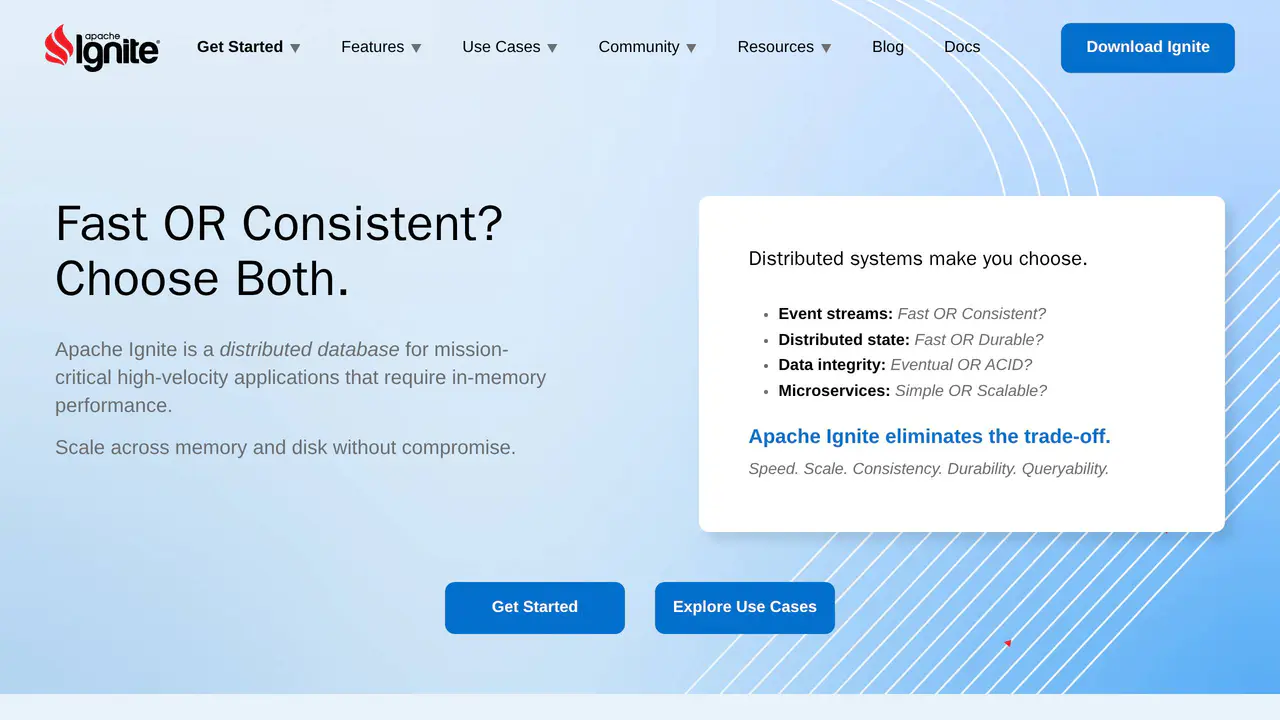
Apache Ignite is a distributed database for mission-critical high-velocity applications that require in-memory performance.
Bi-directional synchronization across multiple back-end systems introduces eventual consis · RocksDB storage engine is experimental and not recommended for production deployments
Eventual consistency windows may exist during synchronization delays. Conflict resolution strategies needed for bi-directional synchronization. Monitoring required to detect synchronization failures.
Table API with RecordView and KeyValueView for typed and partial-update access · ANSI SQL with DDL, DML, joins, aggregations, and subqueries across cluster nodes · Exposes a REST API for programmatic administration including SQL queries, table management
RecordView provides typed access to complete table rows. Methods accept and return objects matching the table schema. The API handles serialization automatically.
CacheStore interface in Ignite 2 enables write-through and write-behind synchronization wi · Standard JDBC drivers with automatic failover and connection pooling · Integrates with Prometheus, Grafana, Datadog, and any OpenTelemetry-compatible monitoring
Ignite 2 provides CacheStore interface for write-through and write-behind synchronization.
Memory-first architecture delivers microsecond latencies; data lives in RAM, not behind di · AIPERSIST persistent storage tier with sub-millisecond latency · AIMEM in-memory storage tier with microsecond-level access
Memory-first architecture delivers microsecond latencies. Data lives in RAM, not behind disk I/O.
This profile connects the jobs Apache Ignite is described as handling with its delivery model, access options and the subjects used to match it to related products in this directory.
Each fact points to a recorded source, making it easy to distinguish verified product information from claims that need checking.
HTTP 200 verified twice
Distributed Database - Apache Ignite®
Apache Ignite is a leading distributed database management system for high-performance com · Apache Ignite provides a memory-first distributed SQL database for high-velocity workloads · Its memory-first architecture delivers microsecond latencies with data in RAM.
Leading distributed database management system for high-performance computing with in-memory speed
Distributed database for mission-critical high-velocity applications that require in-memory performance
Memory-first distributed SQL database that eliminates the scale/speed trade-off for high-velocity workloads
Memory-first architecture delivers microsecond latencies; data lives in RAM, not behind disk I/O
Schema-driven colocation that keeps related data together, eliminating cross-node join penalties
ACID transactions across partitions with Raft consensus and no eventual consistency compromises
Apache Ignite 3 version 3.1.0 — current generation with redesigned architecture, simplified operations, and enhanced developer experience
Apache Ignite 2 version 2.18.0 — long-term support (LTS) generation, production-proven for enterprise workloads
Low-latency shared store for digital integration hub architectures that aggregates data from multiple back-end systems into a unified data access layer
A concise view of the jobs, capabilities and integrations described in the recorded product sources.
Documented product formats, platforms and official distribution destinations. Availability can vary by region and plan.
A concise history of software releases and material product changes. Events appear only when a dated source supports what changed.
This profile is being checked for dated releases and material product changes. Nothing appears here until the exact date and event can be verified from a recorded source.
Facts, answers, structured details, milestones and primary resource links cite this shared ledger. Each external page appears once; release tags from the same GitHub project are grouped under one release history.
These tools share a workflow, capability or audience with Apache Ignite. They may complement it rather than replace it, and are not presented as integrations or endorsements.
CacheStore interface in Ignite 2 enables write-through and write-behind synchronization with external databases
Bi-directional synchronization across multiple back-end systems introduces eventual consistency windows and requires conflict resolution and monitoring
ACID transactions with distributed SQL and compute capabilities
Memory-first architecture with MVCC and Raft-based distributed replication
Raft consensus-based replication for durability and availability
AIPERSIST persistent storage tier with sub-millisecond latency
AIMEM in-memory storage tier with microsecond-level access
RocksDB storage engine is experimental and not recommended for production deployments
Native clients for Java, .NET, C++, Python, and other languages
Standard JDBC drivers with automatic failover and connection pooling
Table API with RecordView and KeyValueView for typed and partial-update access
ANSI SQL with DDL, DML, joins, aggregations, and subqueries across cluster nodes
Schema-driven data placement with colocateBy annotation and distribution zones
Apache Ignite 2.18.0 released
Exports metrics using OpenTelemetry standards for monitoring through standard observability stacks
Integrates with Prometheus, Grafana, Datadog, and any OpenTelemetry-compatible monitoring system
Exposes SQL system views for cluster state including node status, partition distribution, transaction state, and running jobs
Supports username/password authentication with configurable authentication providers
Enables SSL/TLS for client-to-cluster and node-to-node communication with standard certificate formats
Provides fine-grained access control with read, write, or admin privileges per user for multi-tenant deployments
Exposes a REST API for programmatic administration including SQL queries, table management, and cluster state
Provides the Ignite CLI for cluster management including starting/stopping nodes, creating tables, executing SQL, and inspecting topology
DataStreamer delivers high-throughput ingestion with automatic backpressure control using reactive Publisher patterns
Supports transactional streaming writes with atomic batch commits, automatic rollback, and upsert operations
Executes compute jobs on nodes holding the data (colocated compute), eliminating network overhead
Uses Hybrid Logical Clock (HLC) to provide total ordering of events across nodes without external clock synchronization
Memory-first architecture delivering microsecond latencies with data living in RAM · ACID transactions across partitions with Raft consensus · Schema-driven colocation keeping related data together
Memory-first architecture delivering microsecond latencies with data living in RAM rather than behind disk I/O


