Typesense Cloudper month
Support Plans starting at $0/month + Cluster Costs starting $22/month
- Production Support SLA from 30 mins 24x7x365, Full API Access, SOC 2 (Type 2) Compliance
Loading the latest directory information.
Start here for the decision-making essentials: what Typesense does, who it is for, how it is accessed, and the first-party sources behind this profile.
Support Plans starting at $0/month + Cluster Costs starting $22/month
Typesense is an open-source, typo-tolerant search engine built in C++ with sub-50ms latency. It delivers vector search, semantic search, built-in RAG, and Raft-based clustering, deployable via Docker, binaries, or Typesense Cloud with SOC 2 Type 2 compliance.
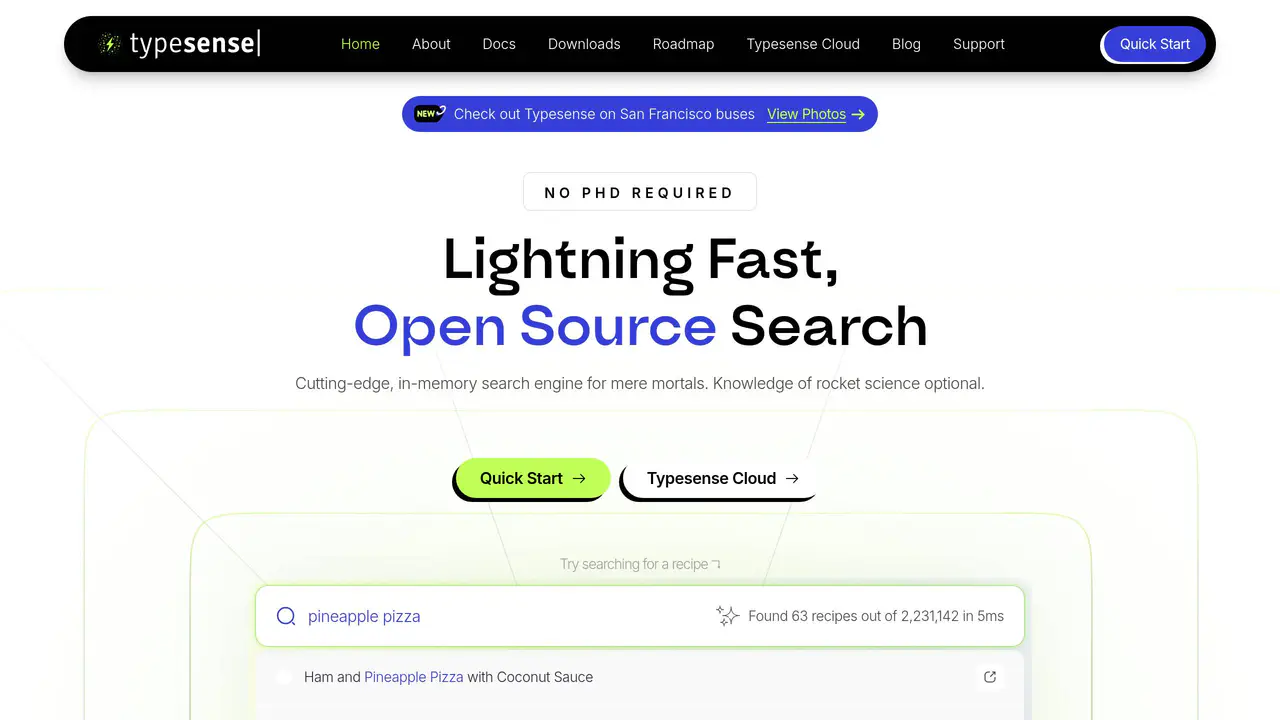
Read-only public captures of Typesense’s homepage. Screenshots are dated, never live embeds, and open full-screen.
Short answers to the questions buyers and builders commonly ask about Typesense. Each answer cites the shared ledger below, where every source is listed once.
Open-source typo-tolerant search engine for fast site and app search, with simple APIs, ve · Built-in RAG alongside vector and semantic search · Search-as-you-type, autocomplete, faceted navigation, geo search, fuzzy search, recommenda · Built-in typo tolerance
Typesense is an open-source search engine for fast, typo-tolerant site and app search, with simple APIs, vector search, and self-hosting.
Developer market
starting with a dev market we were most familiar with, in San Francisco
Typo-tolerant fuzzy search-as-you-type for autocomplete and search results pages · Ecommerce merchandising and curation of search results · Site and app search
Typo-tolerant fuzzy search-as-you-type to power autocomplete search bars and search results pages
Not recommended as a primary data store; should be used as a secondary index synced from a · Raft requires a quorum; a minimum of 3 nodes is needed to tolerate a 1-node failure, and a · A Typesense cluster with N nodes can tolerate failure of at most (N-1)/2 nodes without aff · If a cluster loses more than (N-1)/2 nodes, it loses quorum and stops accepting writes and
Typesense should NOT be used as a primary data store, which stores the only copy of your data.
Cloud Support Plans starting at $0/month + Cluster Costs starting at $22/month; Self-hoste
Cost | Support Plans starting at $0/month + Cluster Costs starting $22/month | Free
Provides an API reference for the search engine
Typesense documentation explains how to install, configure, and use the search engine, with guides, API references, demos, and support links.
This profile connects the jobs Typesense is described as handling with its delivery model, access options and the subjects used to match it to related products in this directory.
Each fact points to a recorded source, making it easy to distinguish verified product information from claims that need checking.
HTTP 200 verified twice
Typesense | Open Source Alternative to Algolia + Pinecone
Open-source search engine for fast, typo-tolerant site and app search · Built-in RAG alongside vector and semantic search · Built in C++ for low-latency (<50ms) searches
Open-source typo-tolerant search engine for fast site and app search, with simple APIs, vector search, and self-hosting
Built-in RAG alongside vector and semantic search
Search-as-you-type, autocomplete, faceted navigation, geo search, fuzzy search, recommendations, federated search, and geo-distributed cache
true
Self-host via Docker, native binaries, RPM, or DEB packages, or provision via Typesense Cloud
Linux, macOS, Docker
Cloud Support Plans starting at $0/month + Cluster Costs starting at $22/month; Self-hosted is Free
Typesense, Inc.
Democratize search by making powerful search technology accessible to everyone
A concise view of the jobs, capabilities and integrations described in the recorded product sources.
Documented product formats, platforms and official distribution destinations. Availability can vary by region and plan.
A concise history of software releases and material product changes. Events appear only when a dated source supports what changed.
Showing the newest updates and meaningful milestones. Open an entry for its summary and source.
Typesense Cloud achieved SOC2 Type 2 certification by an independent external auditor, alongside other milestones including 10K GitHub stars and 3M Docker downloads.
View source [9]Facts, answers, structured details, milestones and primary resource links cite this shared ledger. Each external page appears once; release tags from the same GitHub project are grouped under one release history.
These tools share a workflow, capability or audience with Typesense. They may complement it rather than replace it, and are not presented as integrations or endorsements.
SOC 2 (Type 2) Compliance for Typesense Cloud
Built-in typo tolerance
Vector search and nearest-neighbor search over ML embeddings
Semantic and hybrid search with built-in models like S-BERT and E-5 or external APIs like OpenAI/PaLM
Conversational search (built-in RAG) over indexed JSON data
Voice search via Whisper transcription
Image search via the CLIP model
Scoped API keys for multi-tenant access control
Distributed, highly available cluster via Raft-based clustering
Single binary with no runtime dependencies, runnable locally or in production with a single command
Built in C++ for low-latency (<50ms) searches
Typo-tolerant fuzzy search-as-you-type for autocomplete and search results pages
Not recommended as a primary data store; should be used as a secondary index synced from another primary database
Uses the Raft consensus algorithm to manage clusters and recover from node failures
Automatically and continuously replicates the entire dataset to all nodes in a cluster
Read API calls served by the receiving node; write API calls are automatically forwarded to the cluster leader
Load-balanced endpoint distributes requests across nodes and quarantines nodes with infrastructure issues, rerouting traffic to healthy nodes
Typesense Cloud HA clusters can be launched or modified to run between 3 and 7 nodes
Default HA cluster in Typesense Cloud runs 3 nodes, tolerating a 1-node failure
Raft requires a quorum; a minimum of 3 nodes is needed to tolerate a 1-node failure, and a 5-node cluster tolerates up to 2 node failures but with slightly higher write latencies
A Typesense cluster with N nodes can tolerate failure of at most (N-1)/2 nodes without affecting reads or writes
If a cluster loses more than (N-1)/2 nodes, it loses quorum and stops accepting writes and reads until manual intervention
Official client libraries handle health-checking and traffic re-routing client-side, with a nearestNode parameter for use with server-side load balancing
Text match scoring using frequency, edit distance, proximity, and field weighting heuristics
Tie-breaking ranking using up to two user-defined indexed numerical or string fields
Combined relevance and popularity/recency ranking via bucketing (buckets or bucket_size)
Promote or hide specific records via Overrides (Curation) and pinned_hits/hidden_hits parameters
Automatic typo tolerance that can be tuned per query