

HTTP 200 verified twice
Memory systems · Tool
Supermemory
ResearchedContext infrastructure for AI agents providing persistent, structured memory built as a knowledge graph with sub-300ms hybrid search. Works with any model, handles diverse data types, and offers connectors, plugins, and enterprise compliance.
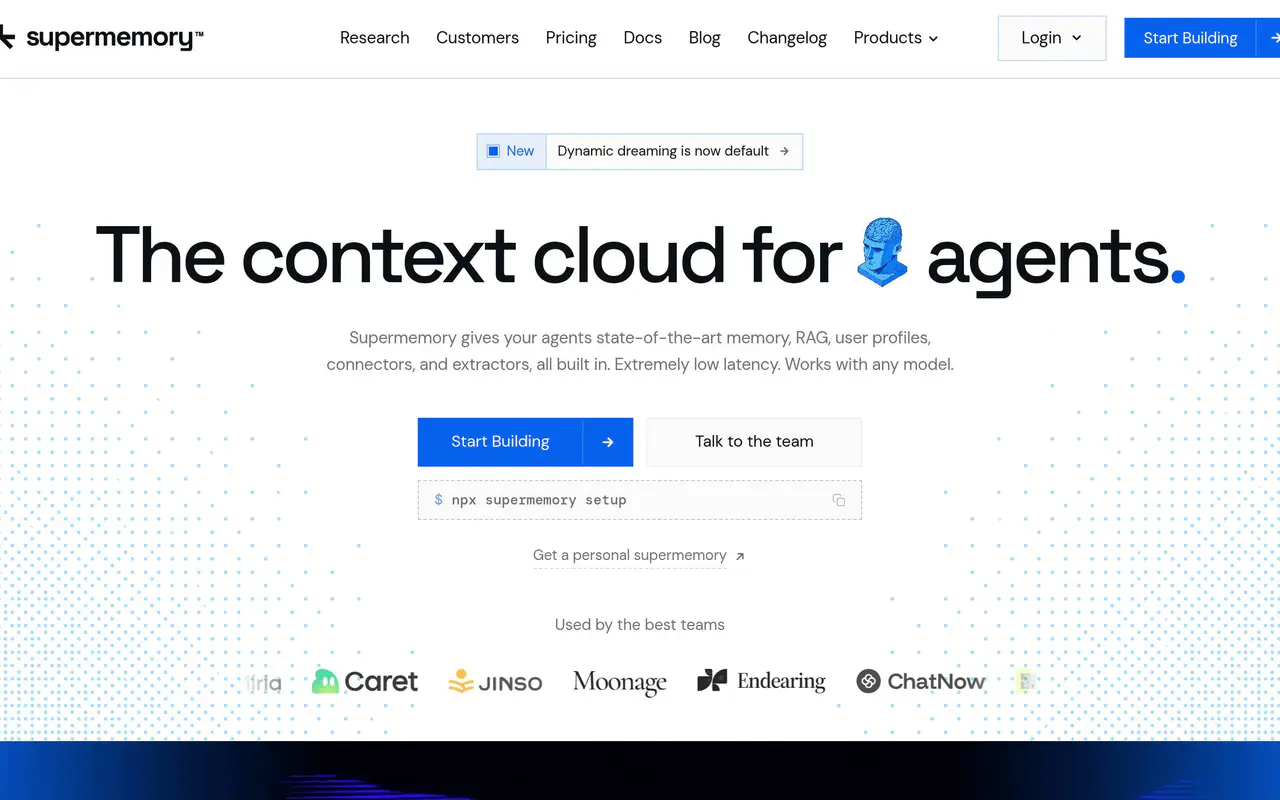
Official site snapshots
Visit live site See the official site at a glance
Read-only public captures of Supermemory’s homepage. Screenshots are dated, never live embeds, and open full-screen.
1 earlier capture
In one minute
Start here for the decision-making essentials: what Supermemory does, who it is for, how it is accessed, and the first-party sources behind this profile.
Pricing5 options
Free tier available to start building
Usage-based pricing with $5 of free monthly usage
paid tiers: Pro $19/mo, Max $100/mo, Sc
Free to get started (Hermes agent integration)
The Claude Code, Cursor, and OpenCode plugins are free and no longer require a paid plan
Platforms
Web
API accessNot public
FoundedNot disclosed by source
AvailabilityWeb / remote
LicenseProprietary
Best suited to
Source-backed fit Teams building AI agents that need persistent user memory Developers replacing fragile RAG stacks with a unified memory API Companies wanting fast agent-context integration Organizations needing SOC 2 and HIPAA-compliant agent memory
Decision support
5 sourced answersCommon questions and adoption checks
Short answers to the questions buyers and builders commonly ask about Supermemory. Each answer cites the shared ledger below, where every source is listed once.
01What does Supermemory help with?
Persistent, structured memory built as a knowledge graph using a custom user understanding · Hybrid search, reranking, and structured context for documents at sub-300ms latency (Super · Extractors that turn PDFs, web pages, images, audio, and raw files into agent-ready memory · One memory API that replaces fragile RAG stacks and stitched-together vector databases
Supermemory
Ledger citation[1] supermemory.ai
02Who is Supermemory intended for?
Teams building AI agents that need persistent user memory · Developers replacing fragile RAG stacks with a unified memory API · Companies wanting fast agent-context integration (days, not quarters) · Organizations needing SOC 2 and HIPAA-compliant agent memory
Customers have integrated Supermemory in a single day
Ledger citation[3] supermemory.ai/case-studies
03What pricing information is available for Supermemory?
Free tier available to start building · Usage-based pricing with $5 of free monthly usage; paid tiers: Pro $19/mo, Max $100/mo, Sc · Free to get started (Hermes agent integration) · The Claude Code, Cursor, and OpenCode plugins are free and
Free tier available to start building
Ledger citation[3] supermemory.ai/case-studies
04Does Supermemory document API access?
No public API access is listed in the recorded profile sources.
One memory API that replaces fragile RAG stacks and stitched-together vector databases
Ledger citation[3] supermemory.ai/case-studies
05What integrations does Supermemory document?
Connectors for Slack, Notion, Drive, Gmail, GitHub, S3, and custom sources with automatic · Customers have integrated Supermemory in a single day · API, OpenClaw, Hermes agent, AI SDK, Mastra (with @supermemory/tools v2.0.0) · Supermemory provides plugins for Claude Code, Cursor, and OpenCode. · Google Drive
Connectors for Slack, Notion, Drive, Gmail, GitHub, S3, and custom sources with automatic syncing
Ledger citation[1] supermemory.ai
Decision guide
Memory systemsCapabilities and operating fit
This profile connects the jobs Supermemory is described as handling with its delivery model, access options and the subjects used to match it to related products in this directory.
Common use cases
- Long-term and short-term memory for AI agents
- Storing, extracting, retrieving, and operating on agent context
- Providing perfect recall about users for personalized AI agents
- Building semantic understanding graphs over users, documents, and projects
- Powering agents through SMFS (Supermemory Filesystem)
- Context infrastructure for AI agents
Topics mapped
Verified capabilities
- Persistent, structured memory built as a knowledge graph using a custom user understanding
- Hybrid search, reranking, and structured context for documents at sub-300ms latency (Super
- Extractors that turn PDFs, web pages, images, audio, and raw files into agent-ready memory
- One memory API that replaces fragile RAG stacks and stitched-together vector databases
- Per-user memory graph with auto-built profiles and fact hierarchies that let agents learn
- Long-term and short-term memory and context infrastructure for AI agents
- State of the art across LongMemEval and LoCoMo benchmarks
- Ingests text, conversations, files (PDF, Images, Docs), and videos
Recorded integrations
Connectors for Slack, Notion, Drive, Gmail, GitHub, S3, and custom sources with automatic Customers have integrated Supermemory in a single dayAPI, OpenClaw, Hermes agent, AI SDK, Mastra (with @supermemory/tools v2.0.0)Supermemory provides plugins for Claude Code, Cursor, and OpenCode.Google DriveNotion
Access signals
- Pricing model
- Free tier available to start building · Usage-based pricing with $5 of free monthly usage; paid tiers: Pro $19/mo, Max $100/mo, Sc · Free to get started (Hermes agent integration) · The Claude Code, Cursor, and OpenCode plugins are free and no longer require a paid plan;
- API
- Not publicly listed
- Source links
- 7 recorded
Source-backed
Updated July 20, 2026Verified facts
Each fact points to a recorded source, making it easy to distinguish verified product information from claims that need checking.
Supermemory
Persistent, structured memory built as a knowledge graph with custom graph engine · Hybrid search, reranking, and structured context at sub-300ms latency · Works with any model
Persistent, structured memory built as a knowledge graph using a custom user understanding model, powered by dynamic dreaming and a custom graph engine
Hybrid search, reranking, and structured context for documents at sub-300ms latency (SuperRAG)
Native POSIX filesystem on macOS and Linux (uses ls, cat, and grep)
Connectors for Slack, Notion, Drive, Gmail, GitHub, S3, and custom sources with automatic syncing
Extractors that turn PDFs, web pages, images, audio, and raw files into agent-ready memory objects with smart chunking
View 32 more verified facts
Works with any model
One memory API that replaces fragile RAG stacks and stitched-together vector databases
Product lineup includes Connectors, MCP Plugins, RAG, Memory Graph, Personal App, and Developer Console
Developer Console provides API keys, usage data, and documentation
Free tier available to start building
Context infrastructure for AI agents
Customers have integrated Supermemory in a single day
Usage-based pricing with $5 of free monthly usage; paid tiers: Pro $19/mo, Max $100/mo, Scale $399/mo; Enterprise custom
Context infrastructure for AI agents — storing, extracting, retrieving, and operating on agent context
Products include Connectors, MCP, Plugins, RAG, Memory Graph, and a Personal App
Per-user memory graph with auto-built profiles and fact hierarchies that let agents learn in real time
Supermemory API token pricing: $0.005 per 1K SM tokens; Rich content at $0.010 (described as 2× cheaper)
Scale tier includes SOC 2 and HIPAA BAA compliance with a self-hosted option; Enterprise offers air-gapped self-hosting, dedicated managed instances, SOC 2, HIPAA, GDPR, custom contracts, DPA, uptime SLA, and a priority Slack channel
Long-term and short-term memory and context infrastructure for AI agents
State of the art across LongMemEval and LoCoMo benchmarks
Providing perfect recall about users to build AI agents that are more intelligent, personalized, and consistent
Ingests text, conversations, files (PDF, Images, Docs), and videos
Builds a semantic understanding graph on top of entities such as users, documents, projects, or organizations
Bundled context stack including agent memory, content extraction, connectors and syncing, and a managed RAG platform
Memory layer for AI agents
SMFS (Supermemory Filesystem) - filesystem redesigned for agents with special files, structures, and commands
Used by hundreds of companies to power their agents
Dynamic Dreaming - automatically connects the dots
API, OpenClaw, Hermes agent, AI SDK, Mastra (with @supermemory/tools v2.0.0)
Free to get started (Hermes agent integration)
Supermemory offers products including Connectors, MCP, Plugins, RAG, Memory Graph, and Personal App.
Supermemory provides plugins for Claude Code, Cursor, and OpenCode.
The Claude Code, Cursor, and OpenCode plugins are free and no longer require a paid plan; free-tier accounts can use them.
Scoped API keys that can add memories can now call the v4 conversations endpoint (POST /v4/conversations) with the same container-tag and write-access protections as memory ingestion.
Supermemory offers a self-hosted server that turns documents into memories and supports search.
The TypeScript SDK allows calling client.search() once with a searchMode parameter to return memories, documents, or both.
Handles extraction for text, conversations, files (PDF, Images, Docs), and videos
Practical capabilities
8 documented areasWhat it helps with
A concise view of the jobs, capabilities and integrations described in the recorded product sources.
Long-term and short-term memory for AI agents
Storing, extracting, retrieving, and operating on agent context
Providing perfect recall about users for personalized AI agents
Building semantic understanding graphs over users, documents, and projects
Powering agents through SMFS (Supermemory Filesystem)
Context infrastructure for AI agents
Providing perfect recall about users to build AI agents that are more intelligent, persona
Used by hundreds of companies to power their agents
Availability
Source checkedWhere it runs and where to get it
Documented product formats, platforms and official distribution destinations. Availability can vary by region and plan.
Cost / license
Free tier available to start building · Usage-based pricing with $5 of free monthly usage; paid tiers: Pro $19/mo, Max $100/mo, Sc · Free to get started (Hermes agent integration) · The Claude Code, Cursor, and OpenCode plugins are free and no longer require a paid plan;
Platforms
Native POSIX filesystem on macOS and Linux (uses ls, cat, and grep)Product lineup includes Connectors, MCP Plugins, RAG, Memory Graph, Personal App, and DeveProducts include Connectors, MCP, Plugins, RAG, Memory Graph, and a Personal AppSupermemory offers products including Connectors, MCP, Plugins, RAG, Memory Graph, and Per
Adoption notes
DeploymentSupermemory offers a self-hosted server that turns documents into memories and supports se · Cloud services
LicenseNot disclosed by source
Model supportWorks with any model
Data controlScale tier includes SOC 2 and HIPAA BAA compliance with a self-hosted option; Enterprise o
Learning curveIntermediate
Primary use casesLong-term and short-term memory for AI agents, Storing, extracting, retrieving, and operating on agent context, Providing perfect recall about users for personalized AI agents, Building semantic understanding graphs over users, documents, and projects, Powering agents through SMFS (Supermemory Filesystem), Context infrastructure for AI agents, Context infrastructure for AI agents — storing, extracting, retrieving, and operating on a, Providing perfect recall about users to build AI agents that are more intelligent, persona, Used by hundreds of companies to power their agents
What to verify before adopting
Evolution and major updates
Research in progressSupermemory timeline
A concise history of software releases and material product changes. Events appear only when a dated source supports what changed.
Scheduled for research
Building a reliable release history.
This profile is being checked for dated releases and material product changes. Nothing appears here until the exact date and event can be verified from a recorded source.
Dated event Short explanation Original source
Citation ledger
7 unique pagesRecorded sources
Facts, answers, structured details, milestones and primary resource links cite this shared ledger. Each external page appears once; release tags from the same GitHub project are grouped under one release history.
- 1supermemory.ai 9 facts · 2 answers · Official site
- 2supermemory.ai/docs/intro 10 facts · Documentation
- 3supermemory.ai/case-studies 6 facts · 3 answers · Official site
- 4supermemory.ai/blog 6 facts · Official site
- 5supermemory.ai/changelog 6 facts · Official site
- 6supermemory.ai/pricing 6 facts · Pricing
- 7supermemory.ai/privacy 6 facts · Security
Research status48 substantive facts · 7 source pages · quality score 91/100