


HTTP 200 verified twice
Finding your next stop…
Loading the latest directory information.
Loading the latest directory information.
Start here for the decision-making essentials: what Push Security does, who it is for, how it is accessed, and the first-party sources behind this profile.
Monthly billing
Push Security is an enterprise browser security platform delivered as a browser extension. It combines browser telemetry, real-time controls, and autonomous AI agents to stop identity attacks, secure AI usage, harden identities, and prevent data loss.
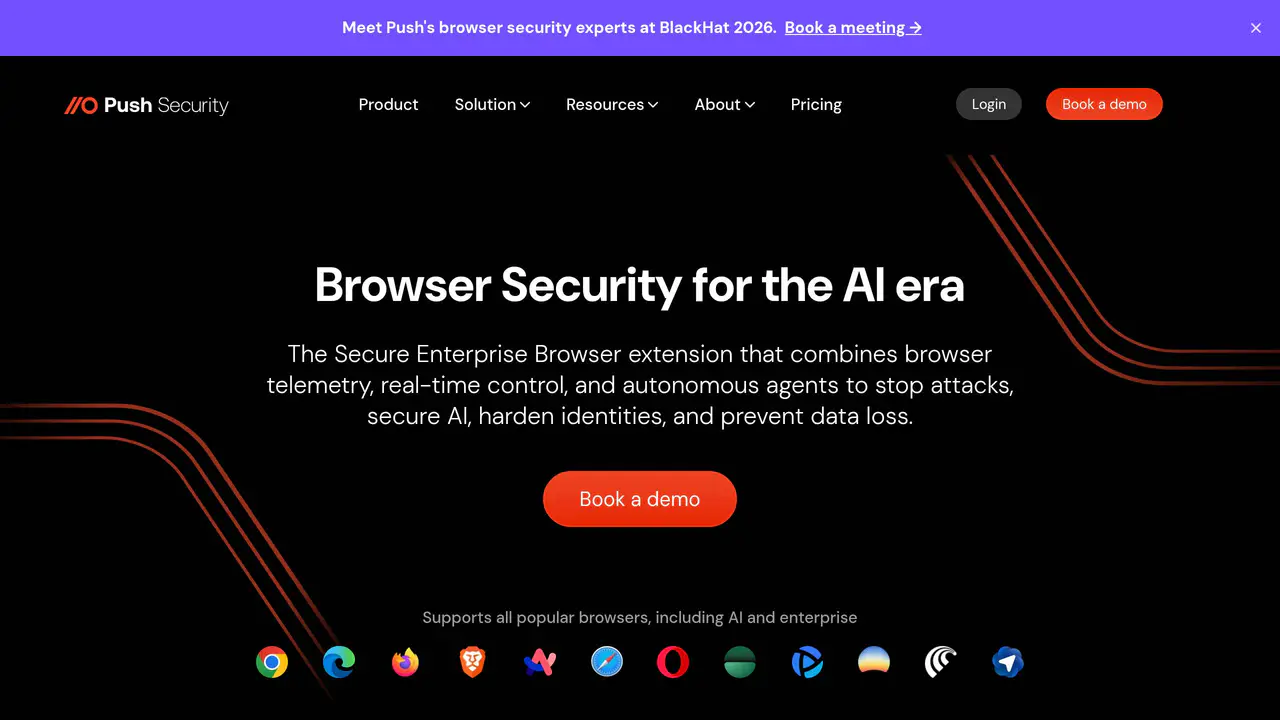
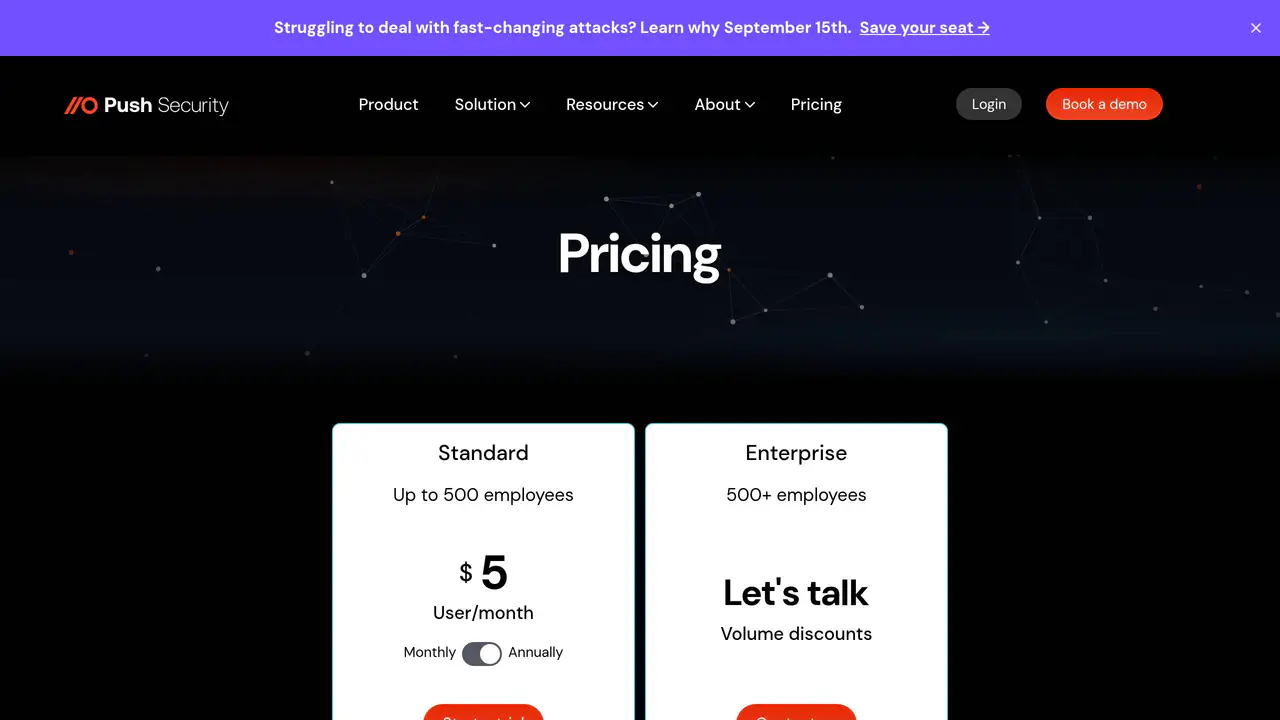
Read-only public captures of Push Security’s homepage and verified pricing page. Screenshots are dated, never live embeds, and open full-screen.
Short answers to the questions buyers and builders commonly ask about Push Security. Each answer cites the shared ledger below, where every source is listed once.
Enterprise browser security that combines browser telemetry, real-time control, and autono · Browser-based detection and response, positioned as "EDR, but in the browser" · Domain-binds passwords to their legitimate domain to stop credential phishing · Discovers shadow SaaS and shadow AI by monitoring browser activity in real time
combines browser telemetry, real-time control, and autonomous agents to stop attacks, secure AI, harden identities, and prevent data loss.
Enterprise security teams, CISOs, and blue teams defending highly targeted organizations · Enterprise security administrators who manage employee identities, apps, and browser-based
how Push solved key security challenges and delivered real business value for serious security professionals, defending highly targeted organizations.
Governs generative AI tool usage with AI classification, in-browser acceptable use banners · Provides full visibility into corporate identity, app, and account attack surface, includi
Push blocks shadow AI tools deemed non-compliant or too risky directly in the browser. This prevents users from accessing the site or submitting data in the first place.
Monthly billing | $6/employee/month | billed in advance · Annual contract | $5/employee/month | billed in advance · Per-license billing; licenses are assigned to individual humans, not to number of accounts
Push costs $6 per employee/month when billed monthly
REST API for custom integrations; events include attack technique, severity, user, applica · Provides a REST API to programmatically administer the platform, and webhooks for real-tim · Push REST API with API-key authentication for programmatic administration and sharing Push
provides a REST API for custom integrations. All forwarded events include full context: attack technique, severity, user, application, timestamp, and referrer URL.
Native SIEM integrations with Microsoft Sentinel, Splunk Cloud, Datadog, Panther, and Crib · Integrates with Google, Microsoft, and Slack · Integrates via API with identity providers Microsoft 365, Google Workspace, and Okta to sy · Provides real-time detection and security-finding notifications via ChatOps integration wi
Push has native SIEM integrations for Microsoft Sentinel, Splunk Cloud, Datadog, Panther, and Cribl Cloud
This profile connects the jobs Push Security is described as handling with its delivery model, access options and the subjects used to match it to related products in this directory.
Each fact points to a recorded source, making it easy to distinguish verified product information from claims that need checking.
HTTP 200 verified twice
Browser Security for the AI Era | Push Security
Push Security is an enterprise browser security company that delivers detection and respon · Platform combines browser telemetry, real-time control, and autonomous agents · Mission is to stop identity attacks in the browser
Push Security
Enterprise browser security that combines browser telemetry, real-time control, and autonomous agents to stop attacks, secure AI, harden identities, and prevent data loss.
Browser extension / SecurityApplication
Chrome, Edge, Firefox, Safari, Brave, Opera, Arc, plus enterprise browsers Island and Prisma Access Browser, and agentic browsers Comet, Atlas, and Dia
Monthly billing | $6/employee/month | billed in advance
Annual contract | $5/employee/month | billed in advance
Force-installed via MDM (Intune, Jamf, Google Admin Console), distributed through email enrollment, or self-enrolled by employees via a landing page; supports BYOD/unmanaged devices without MDM; Incognito mode force-install on Chrome/Edge (
Native SIEM integrations with Microsoft Sentinel, Splunk Cloud, Datadog, Panther, and Cribl Cloud; Slack and Microsoft Teams alerts; native Tines SOAR integration; IdP integrations with Google Workspace, Microsoft 365, and Okta.
A concise view of the jobs, capabilities and integrations described in the recorded product sources.
Documented product formats, platforms and official distribution destinations. Availability can vary by region and plan.
A concise history of software releases and material product changes. Events appear only when a dated source supports what changed.
Showing the newest updates and meaningful milestones. Open an entry for its summary and source.
Push Security detailed the 'LLMShare' technique, in which attackers abuse shared ChatGPT and Claude conversation pages on trusted domains to deliver malware via search engine malvertising.
View source [12]Push Security detailed LLMShare, an attack technique that abuses shared-content features on AI chatbot platforms such as ChatGPT and Claude to distribute malware.
View source [12]Push Security investigated ConsentFix v3, a new criminal OAuth-consent attack toolkit promoted on forums, and linked it to a December 2025 state-sponsored campaign.
View source [21]Push Security disclosed a new wave of AiTM phishing pages targeting TikTok for Business accounts, with linked phishing domains registered on 24 March within a nine-second window.
View source [14]Push Security identified a new wave of adversary-in-the-middle phishing pages using session-stealing kits to hijack business TikTok accounts.
View source [14]Push Security published an analysis of the 'Scattered Lapsus$ Hunters' threat collective, documenting the group's tactics, techniques, and breaches since 2021.
View source [13]Push Security published a research analysis examining breaches attributed to the 'Scattered Lapsus$ Hunters' collective since 2021 and how the attackers exploit gaps in modern security stacks.
View source [13]Facts, answers, structured details, milestones and primary resource links cite this shared ledger. Each external page appears once; release tags from the same GitHub project are grouped under one release history.
These tools share a workflow, capability or audience with Push Security. They may complement it rather than replace it, and are not presented as integrations or endorsements.
REST API for custom integrations; events include attack technique, severity, user, application, timestamp, and referrer URL.
Holds SOC 2 Type II, ISO 27001, ISO 27701, GDPR compliance, and Cyber Essentials certifications.
Local-first, detection-triggered data architecture; all platform data stored in the EU (Dublin, with backup in Paris); encrypted at rest with AES-256 and in transit with TLS 1.2+.
Operations in the United Kingdom and the United States; workforce fully remote; cloud hosting predominantly in the EU.
CEO and Co-founder: Adam Bateman
Stops identity attacks in the browser
Browser-based detection and response, positioned as "EDR, but in the browser"
Deploys as a secure browser extension on employee browsers
Domain-binds passwords to their legitimate domain to stop credential phishing
Discovers shadow SaaS and shadow AI by monitoring browser activity in real time
Identifies weak, reused, and leaked passwords plus MFA gaps for attack surface hardening
Distinguishes authentication methods including SSO (SAML, OIDC), password login, and social login
Checks passwords locally against breach lists via Have I Been Pwned k-anonymized hashes without sending passwords anywhere
Governs generative AI tool usage with AI classification, in-browser acceptable use banners, and blocking non-compliant shadow AI tools
Integrates with Google, Microsoft, and Slack
Push Security Inc and its affiliate Push Security Ltd
Push Security
Enterprise browser security without replacing the browser
Real-time detection and blocking of in-browser threats including phishing kits, token theft, and session hijacking
Inspection of page structure, content, and user interaction to spot cloned logins, malicious scripts, and credential misuse
Identity attack surface hardening: flags missing MFA, password reuse, non-SSO logins, shadow apps, and risky extensions
Visibility and controls for AI tool usage (shadow AI apps, agent access, extensions) including what's typed, pasted, uploaded, and authorized
Investigation/incident response: reconstructs user/session timelines from page loads, click paths, credential use, and token activity
Autonomous AI agents for threat hunting, hypothesis development, analysis, and detection engineering
Rapid MDM-based deployment, with a record of 100,000 users in 1 hour during normal office hours
Enterprise security teams, CISOs, and blue teams defending highly targeted organizations
Push Security is an enterprise browser security company providing detection and response without replacing the existing browser, focused on stopping attacks, securing AI usage, and hardening identity attack surface.
Browser-based detection and response platform that stops adversary-in-the-middle (AiTM) phishing, ClickFix-style malicious copy-paste attacks, malicious browser extensions, and other browser-based attacks leading to account takeover, ransom
Deployed as a browser extension to employee browsers via MDM, Google Admin console, Microsoft Group Policy, or manual enrollment.