

Public repository
Agent platforms · Tool
OpenClaw
ResearchedOpen-source personal agent that runs continuously, connects to messaging channels and uses installable skills to perform work across local and online tools.
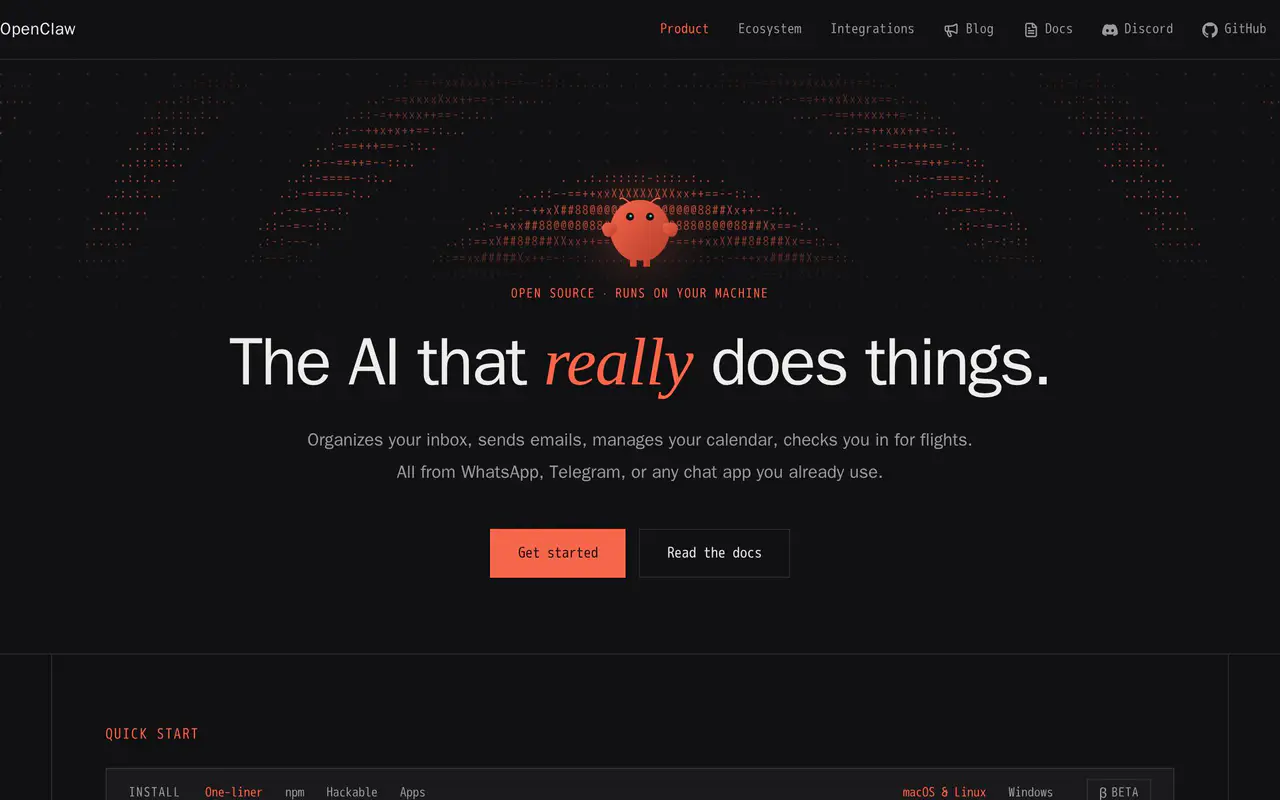
Official site snapshots
Visit live site See the official site at a glance
Read-only public captures of OpenClaw’s homepage. Screenshots are dated, never live embeds, and open full-screen.
1 earlier capture
In one minute
Start here for the decision-making essentials: what OpenClaw does, who it is for, how it is accessed, and the first-party sources behind this profile.
PricingCurrent signal
Free software + model costs
Platforms
Self-hostedDockerMessaging apps
API accessAvailable
Founded2025
AvailabilityWeb / remote
LicenseOpen source
Best suited to
Source-backed fit Technical individuals Self-hosters Automation enthusiasts
Decision support
5 sourced answersCommon questions and adoption checks
Short answers to the questions buyers and builders commonly ask about OpenClaw. Each answer cites the shared ledger below, where every source is listed once.
01What does OpenClaw help with?
Personal automation · Messaging assistant · Background tasks · Messaging integrations
Ledger citation[2] openclaw.ai
02Who is OpenClaw intended for?
Technical individuals · Self-hosters · Automation enthusiasts
Ledger citation[2] openclaw.ai
03What pricing information is available for OpenClaw?
Free software + model costs
Ledger citation[2] openclaw.ai
04Does OpenClaw document API access?
API access is documented by the provider.
Ledger citation[2] openclaw.ai
05What should teams verify before adopting OpenClaw?
Broad tool permissions require careful review and isolation. · Community skills should be audited before installation. · Model-provider subscription and API terms can affect availability.
Ledger citation[2] openclaw.ai
Decision guide
Agent platformsCapabilities and operating fit
This profile connects the jobs OpenClaw is described as handling with its delivery model, access options and the subjects used to match it to related products in this directory.
Common use cases
- Personal automation
- Messaging assistant
- Background tasks
Topics mapped
Access signals
- Pricing model
- Free
- API
- Publicly available
- Source links
- 2 recorded
Source-backed
Updated July 20, 2026Verified facts
Each fact points to a recorded source, making it easy to distinguish verified product information from claims that need checking.
Supported
Core interface
Installable
Practical capabilities
5 documented areasWhat it helps with
A concise view of the jobs, capabilities and integrations described in the recorded product sources.
Personal automation
Messaging assistant
Background tasks
Messaging integrations
Skills and tools
Availability
Source checkedWhere it runs and where to get it
Documented product formats, platforms and official distribution destinations. Availability can vary by region and plan.
Cost / license
FreeFree software + model costsOpen source; confirm repository license for the installed release
Platforms
Self-hostedDockerMessaging apps
Adoption notes
DeploymentSelf-hosted; local or server installation
LicenseOpen source; confirm repository license for the installed release
Model supportBring-your-own supported model providers
Data controlSelf-hosted control with data still subject to selected model and integration providers
Learning curveAdvanced
Primary use casesPersonal automation, Messaging assistant, Background tasks
What to verify before adopting
- Broad tool permissions require careful review and isolation.
- Community skills should be audited before installation.
- Model-provider subscription and API terms can affect availability.
Evolution and major updates
23 dated updatesOpenClaw timeline
A concise history of software releases and material product changes. Events appear only when a dated source supports what changed.
Latest first · exact dates
Showing the newest updates and meaningful milestones. Open an entry for its summary and source.
openclaw 2026.7.1 released
Open detailsOpenClaw v2026.7.1 brings major Control UI and onboarding overhauls, major updates to the official iOS, Android, and macOS apps, expanded model and provider support including GPT-5.6 compatibility, Tencent Hy3, and Meta Muse Spark 1.1, and stronger Codex and c
View source [1]openclaw 2026.6.11 released
Open detailsWe heard the feedback. v2026.6.11 focuses on the rough edges that make OpenClaw feel less dependable, with fixes for misplaced replies, stuck sends, reconnects, model setup failures, and safer admin defaults. Full release notes
View source [1]openclaw 2026.6.10 released
Open detailsAutomatic fast mode starts short conversations quickly, then returns longer or fallback work to normal mode without losing visible state. Provider routing, channel progress, session identity, and trusted tool policies are more reliable, with smaller improvemen
View source [1]openclaw 2026.6.9 released
Open detailsRicher Telegram delivery: Telegram now sends rich HTML, preserves rich markdown and sticker paths, renders progress drafts and command output more faithfully, normalizes HTML tables safely, and keeps mentions and spooled handlers on the right delivery path. (9
View source [1]openclaw 2026.6.8 released
Open detailsRicher channel delivery: Telegram and WhatsApp are less brittle: Telegram renders structured text with tables, lists, expandable blockquotes, preserved intentional line breaks, and CLI-backed replies, while WhatsApp now honors configured ACP bindings. (92679,
View source [1]openclaw 2026.6.6 released
Open detailsTighter security boundaries: transcript, sandbox, MCP, browser, channel, and exec-approval paths now fail closed around unsafe access, timed-out approvals, and malformed boundary input. (91529, 91618, 91741, 91750, 89938) Thanks @joshavant, @pgondhi987, @mmaps
View source [1]openclaw 2026.5.27 released
Open detailsStronger security and content boundaries: group prompt text is kept out of the system prompt, repeated-dot hostnames are normalized, side-effecting command wrappers and unsafe Node runtime env overrides are blocked, no-auth Tailscale exposure is rejected, and
View source [1]openclaw 2026.5.3-1 released
Open detailsCore npm hotfix release for v2026.5.3. Plugins/security: stop the install scanner from blocking official bundled plugin packages when process.env access and normal API sends only appear in distant parts of the same compiled bundle.
View source [1]
View 15 more dated releasesFull source-backed history
Citation ledger
3 unique pagesRecorded sources
Facts, answers, structured details, milestones and primary resource links cite this shared ledger. Each external page appears once; release tags from the same GitHub project are grouped under one release history.
- 1github.com/openclaw/openclaw/releases 23 release milestones
- 2openclaw.ai 5 answers · Official site
- 3github.com/openclaw/openclaw Source code
Research status4 substantive facts · 2 source pages · quality score 70/100
Options to compare
This shortlist contains explicitly listed alternatives to consider alongside OpenClaw for the same job.