

HTTP 200 verified twice
Model providers · Tool
Meta AI
ResearchedMeta AI is a model provider offering the Muse model family for media generation and multimodal reasoning, with free consumer access and a public preview Meta Model API. Developed by Meta Superintelligence Labs, it spans computer vision, generative AI, NLP, and brain-computer interface research.
Official site snapshots
Visit live site See the official site at a glance
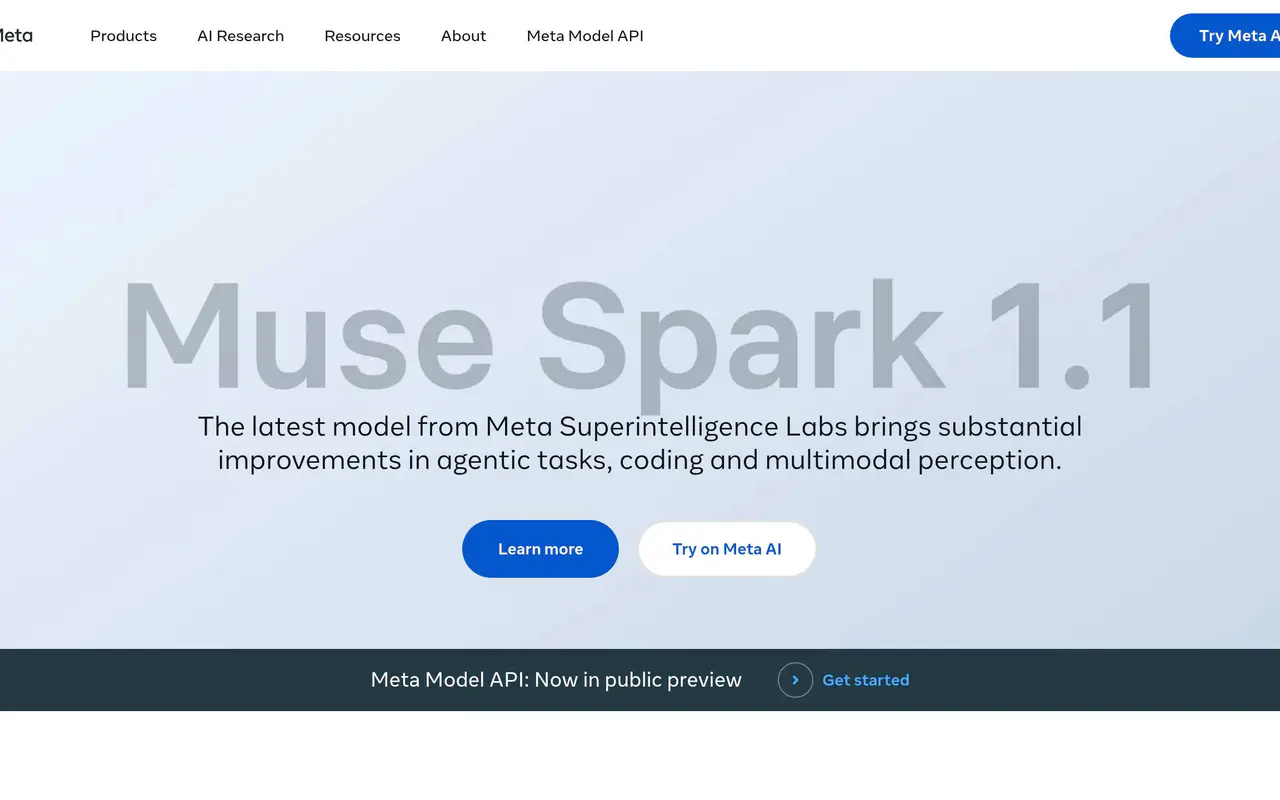
Read-only public captures of Meta AI’s homepage. Screenshots are dated, never live embeds, and open full-screen.
1 earlier capture
In one minute
Start here for the decision-making essentials: what Meta AI does, who it is for, how it is accessed, and the first-party sources behind this profile.
PricingCurrent signal
Free
Platforms
Web
API accessNot public
FoundedNot disclosed by source
AvailabilityWeb / remote
LicenseProprietary
Best suited to
Source-backed fit Developers building agentic applications with multimodal reasoning Creators seeking advanced image and video generation Researchers working on computer vision and world models Teams needing large-context language models via API Neuroscience researchers exploring non-invasive brain-to-text decoding
Decision support
5 sourced answersCommon questions and adoption checks
Short answers to the questions buyers and builders commonly ask about Meta AI. Each answer cites the shared ledger below, where every source is listed once.
01What does Meta AI help with?
Text and visual prompts to detect, segment, and track any object in images or video · DINOv3 scales self-supervised learning (SSL) for images to produce universal vision backbo · Meta AI conducts work across AI Infrastructure, Generative AI, NLP, Computer Vision and ot · Multimodal reasoning model built for agentic tasks with major gains in tool and computer u
AI at Meta: Meta AI Products, Models and Research
Ledger citation[1] ai.meta.com
02Who is Meta AI intended for?
Developers building agentic applications with multimodal reasoning · Creators seeking advanced image and video generation · Researchers working on computer vision and world models · Teams needing large-context language models via API
Ledger citation[1] ai.meta.com
03What pricing information is available for Meta AI?
04Does Meta AI document API access?
No public API access is listed in the recorded profile sources.
Muse model family powers media generation and reasoning · Meta AI is free to try · Meta Model API is now in public preview
Ledger citation[1] ai.meta.com
05What integrations does Meta AI document?
Muse Image integrates with Muse Spark, allowing the two models to share tools and plan joi
Muse Image integrates with Muse Spark, allowing the two models to share tools and plan jointly for agentic media generation
Ledger citation[2] ai.meta.com/blog/introducing-muse-image-muse-video-msl
Decision guide
Model providersCapabilities and operating fit
This profile connects the jobs Meta AI is described as handling with its delivery model, access options and the subjects used to match it to related products in this directory.
Common use cases
- Multimodal reasoning and agentic task automation with tool and computer use
- Image generation, precise editing, and composition from multiple references
- Video generation with native audio support and high visual fidelity
- Object detection, segmentation, and tracking in images and video
- Universal vision backbone training via self-supervised learning
- Non-invasive brain activity decoding into text in real time
Topics mapped
Verified capabilities
- Text and visual prompts to detect, segment, and track any object in images or video
- DINOv3 scales self-supervised learning (SSL) for images to produce universal vision backbo
- Meta AI conducts work across AI Infrastructure, Generative AI, NLP, Computer Vision and ot
- Multimodal reasoning model built for agentic tasks with major gains in tool and computer u
- 1 million token context window with active context management
- Muse Image operates as an agent that invokes search and coding tools to improve accuracy,
- Brain2Qwerty uses AI to decode brain activity into text without any surgical implant (non-
Recorded integrations
Access signals
- Pricing model
- Free
- API
- Not publicly listed
- Source links
- 5 recorded
Source-backed
Updated July 20, 2026Verified facts
Each fact points to a recorded source, making it easy to distinguish verified product information from claims that need checking.
AI at Meta: Meta AI Products, Models and Research
Muse model family powers media generation and reasoning · Meta AI is free to try · Meta Model API is now in public preview
Muse model family
Free
Meta Model API in public preview
Text and visual prompts to detect, segment, and track any object in images or video
V-JEPA 2, the first world model trained on video
View 25 more verified facts
DINOv3 scales self-supervised learning (SSL) for images to produce universal vision backbones
SAM 2 is a segmentation model that enables fast, precise selection of any object in any video or image.
DINOv3 scales self-supervised learning (SSL) for images to produce Meta's strongest universal vision backbones.
V-JEPA 2 is described as the first world model trained on video that achieves state-of-the-art visual understanding and prediction.
Movie Gen is described as the most advanced family of media foundation AI models empowering immersive storytelling.
Meta AI conducts work across AI Infrastructure, Generative AI, NLP, Computer Vision and other core areas of AI.
Meta AI's responsible AI core principles are Privacy & Security, Fairness & Inclusion, Robustness & Safety, Transparency & Control, and Accountability & Governance.
Muse Spark 1.1
Multimodal reasoning model built for agentic tasks with major gains in tool and computer use, coding, and multimodal understanding
1 million token context window with active context management
Public preview of the new Meta Model API launched for developers to access Muse Spark 1.1
Available in "Thinking" mode in the Meta AI app and on meta.ai
Developed by Meta Superintelligence Labs
Muse Image is Meta's most advanced image generation model that follows instructions faithfully, edits with precision, and composes from multiple references
Muse Video delivers exceptional visual fidelity with native audio support and is built on the same pretraining base as Muse Image
Muse Image and Muse Video are the first media generation models developed by Meta Superintelligence Labs
Muse Image operates as an agent that invokes search and coding tools to improve accuracy, self-refines its own generations, and improves through scaling test-time compute
Muse Image integrates with Muse Spark, allowing the two models to share tools and plan jointly for agentic media generation
Muse Image is available on the Meta AI app, meta.ai, Instagram Stories in the US, and WhatsApp in limited countries, and is coming soon to Facebook; Muse Video is coming soon to creators and Meta AI
Brain2Qwerty uses AI to decode brain activity into text without any surgical implant (non-invasive).
Brain2Qwerty v2 is an end-to-end deep learning pipeline that decodes sentences from raw brain signals in real time.
Brain2Qwerty v2 achieves a 61% word accuracy rate, improving on the 8% word accuracy of other non-invasive methods.
For the best participant, Brain2Qwerty v2 achieves 78% word accuracy, with more than half of all sentences decoded with one word error or less.
Brain2Qwerty v2 was trained on data captured from participants typing while wearing a magnetoencephalography (MEG) device.
Meta is releasing the full training code for Brain2Qwerty v1 and v2 to accelerate neuroscience research.
Practical capabilities
8 documented areasWhat it helps with
A concise view of the jobs, capabilities and integrations described in the recorded product sources.
Multimodal reasoning and agentic task automation with tool and computer use
Image generation, precise editing, and composition from multiple references
Video generation with native audio support and high visual fidelity
Object detection, segmentation, and tracking in images and video
Universal vision backbone training via self-supervised learning
Non-invasive brain activity decoding into text in real time
Immersive storytelling through media foundation models
Text and visual prompts to detect, segment, and track any object in images or video
Availability
Source checkedWhere it runs and where to get it
Documented product formats, platforms and official distribution destinations. Availability can vary by region and plan.
Cost / license
FreeMeta is releasing the full training code for Brain2Qwerty v1 and v2 to accelerate neurosci
Platforms
Available in "Thinking" mode in the Meta AI app and on meta.aiMuse Image is available on the Meta AI app, meta.ai, Instagram Stories in the US, and WhatBrain2Qwerty v2 was trained on data captured from participants typing while wearing a magn
Adoption notes
DeploymentNot disclosed by source
LicenseMeta is releasing the full training code for Brain2Qwerty v1 and v2 to accelerate neurosci
Model supportMuse model family · V-JEPA 2, the first world model trained on video · SAM 2 is a segmentation model that enables fast, precise selection of any object in any vi · DINOv3 scales self-supervised learning (SSL) for images to produce Meta's strongest univer · V-JEPA 2 is described as the first world model trained on video that achieves state-of-the
Data controlNot disclosed by source
Learning curveIntermediate
Primary use casesMultimodal reasoning and agentic task automation with tool and computer use, Image generation, precise editing, and composition from multiple references, Video generation with native audio support and high visual fidelity, Object detection, segmentation, and tracking in images and video, Universal vision backbone training via self-supervised learning, Non-invasive brain activity decoding into text in real time, Immersive storytelling through media foundation models
What to verify before adopting
Evolution and major updates
Research in progressMeta AI timeline
A concise history of software releases and material product changes. Events appear only when a dated source supports what changed.
Scheduled for research
Building a reliable release history.
This profile is being checked for dated releases and material product changes. Nothing appears here until the exact date and event can be verified from a recorded source.
Dated event Short explanation Original source
Citation ledger
5 unique pagesRecorded sources
Facts, answers, structured details, milestones and primary resource links cite this shared ledger. Each external page appears once; release tags from the same GitHub project are grouped under one release history.
- 1ai.meta.com 9 facts · 4 answers · Official site
- 2ai.meta.com/blog/introducing-muse-image-muse-video-msl 6 facts · 1 answer · Official site
- 3ai.meta.com/about 6 facts · Official site
- 4ai.meta.com/blog/brain2qwerty-brain-ai-human-communication 6 facts · Official site
- 5ai.meta.com/blog/introducing-muse-spark-meta-model-api 6 facts · Documentation
Research status32 substantive facts · 5 source pages · quality score 91/100