


HTTP 200 verified twice
Finding your next stop…
Loading the latest directory information.
Loading the latest directory information.
VulnLLM-R-7B is a 7B-parameter open-source causal language model specialized for software vulnerability detection across C, C++, Python, and Java, using Chain-of-Thought reasoning over data and control flow.
Start here for the decision-making essentials: what VulnLLM R 7B does, who it is for, how it is accessed, and the first-party sources behind this profile.
See official pricing
Read-only public captures of VulnLLM R 7B’s homepage and verified pricing page. Screenshots are dated, never live embeds, and open full-screen.
Published specifications and use cases for VulnLLM R 7B. Repository dates are kept separate from the model's original release date.
These are publisher-reported results. Test conditions and benchmark versions can differ.
Short answers to the questions buyers and builders commonly ask about VulnLLM R 7B. Each answer cites the shared ledger below, where every source is listed once.
Specialized reasoning LLM for software vulnerability detection that generates a Chain-of-T
generates a "Chain-of-Thought" to analyze why a vulnerability exists.
Can be served via a hosted web demo (Demo: Web demo)
Demo: Web demo
Open-source model weights and accompanying code/data available on Hugging Face and GitHub
Code & Data: GitHub
7B parameters
Achieves SOTA performance with only 7B parameters
Publicly hosted on Hugging Face under Virtue-AI-HUB/VulnLLM-R-7B (loadable via AutoModelFo
model_name = "UCSB-SURFI/VulnLLM-R-7B"
Transformer-based causal language model loaded via Hugging Face transformers (AutoModelFor
from transformers import AutoModelForCausalLM, AutoTokenizer
This profile connects the jobs VulnLLM R 7B is described as handling with its delivery model, access options and the subjects used to match it to related products in this directory.
Each fact points to a recorded source, making it easy to distinguish verified product information from claims that need checking.
HTTP 200 verified twice
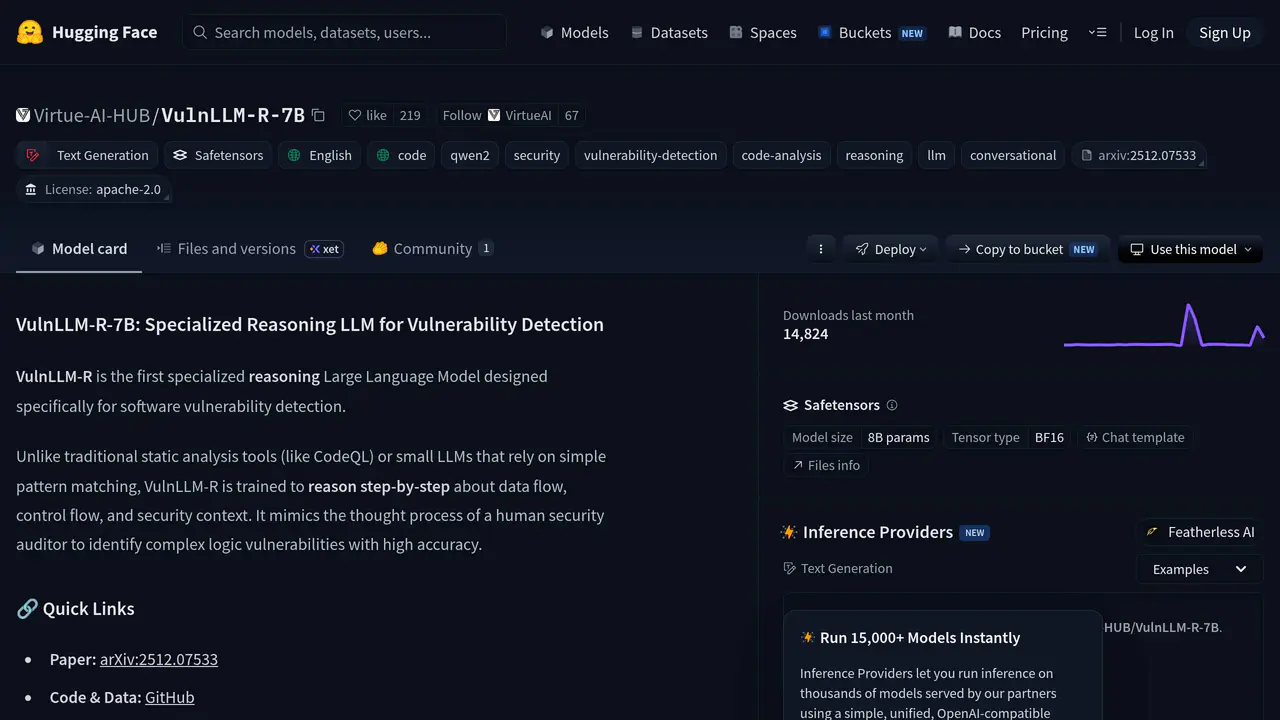
Virtue-AI-HUB/VulnLLM-R-7B · Hugging Face
Model name VulnLLM-R-7B · 7B parameters with state-of-the-art performance · Specialized for software vulnerability detection
VulnLLM-R-7B
Specialized reasoning LLM for software vulnerability detection that generates a Chain-of-Thought to analyze why a vulnerability exists
7B parameters
Chain-of-Thought reasoning over data flow and control flow
C, C++, Python, Java (with zero-shot generalization)
Reported state-of-the-art results on PrimeVul, Juliet 1.3, and ARVO
Transformer-based causal language model loaded via Hugging Face transformers (AutoModelForCausalLM)
Uses bfloat16 (torch_dtype=torch.bfloat16) for inference
Publicly hosted on Hugging Face under Virtue-AI-HUB/VulnLLM-R-7B (loadable via AutoModelForCausalLM.from_pretrained)
A concise view of the jobs, capabilities and integrations described in the recorded product sources.
Documented product formats, platforms and official distribution destinations. Availability can vary by region and plan.
A concise history of software releases and material product changes. Events appear only when a dated source supports what changed.
Showing the newest updates and meaningful milestones. Open an entry for its summary and source.
The public model repository was created on Hugging Face. This repository date may differ from the model's original release date.
View source [1]Facts, answers, structured details, milestones and primary resource links cite this shared ledger. Each external page appears once; release tags from the same GitHub project are grouped under one release history.
These tools share a workflow, capability or audience with VulnLLM R 7B. They may complement it rather than replace it, and are not presented as integrations or endorsements.
Open-source model weights and accompanying code/data available on Hugging Face and GitHub
Can be served via a hosted web demo (Demo: Web demo)
1,559 downloads in the last month on Hugging Face
First specialized reasoning LLM for software vulnerability detection · Generates Chain-of-Thought to analyze why a vulnerability exists · Achieves SOTA with only 7B parameters, 30x smaller than general-purpose reasoning models
Specialized reasoning LLM for software vulnerability detection that generates a Chain-of-Thought to analyze data flow, control flow, and security context.
Reasoning-based detection: generates a 'Chain-of-Thought' to analyze why a vulnerability exists rather than only classifying code.
Software vulnerability detection in source code (e.g., identifying buffer overflows and complex logic vulnerabilities).
VulnLLM-R
VulnLLM-R-7B
C, C++, Python, and Java (zero-shot generalization)
Code (text input)
causal language model loaded via transformers AutoModelForCausalLM
Recommended inference dtype: bfloat16
Loads with Hugging Face transformers AutoModelForCausalLM and AutoTokenizer; supports chat template application and .generate() with max_new_tokens=512 in the example.
Reported state-of-the-art results on PrimeVul, Juliet 1.3, and ARVO (see paper Figure 1 and Table 4).
Reported by authors as outperforming Claude-3.7-Sonnet, o3-mini, CodeQL, and AFL++ on key benchmarks.
Open model weights hosted on Hugging Face Hub with code & data published on GitHub and a web demo available.
Local inference demonstrated via Hugging Face transformers on GPU with device_map='auto' (bfloat16).
Step-by-step reasoning triggered via a prompt template asking the model to analyze code step-by-step before giving a final answer.
Research model authored by Virtue-AI-HUB / UCSB-SURFI team (authors include Nie, Li, Guo, Jiang, Wang, Li, Song, Guo).
Model can be loaded via the transformers library using model_name 'UCSB-SURFI/VulnLLM-R-7B' (example in README).
Model named VulnLLM-R-7B · First specialized reasoning LLM for software vulnerability detection · 7B parameters, 30x smaller than general-purpose reasoning models
Software vulnerability detection
step-by-step reasoning about data flow, control flow, and security context to identify complex logic vulnerabilities
Chain-of-Thought reasoning that analyzes why a vulnerability exists
state-of-the-art on PrimeVul, Juliet 1.3, and ARVO
bfloat16 torch_dtype
PyTorch via Hugging Face Transformers


