

HTTP 200 verified twice
Finding your next stop…
Loading the latest directory information.
Loading the latest directory information.
Start here for the decision-making essentials: what DermaSensor does, who it is for, how it is accessed, and the first-party sources behind this profile.
Available on a monthly rental basis with multiple monthly rental packages based on anticip
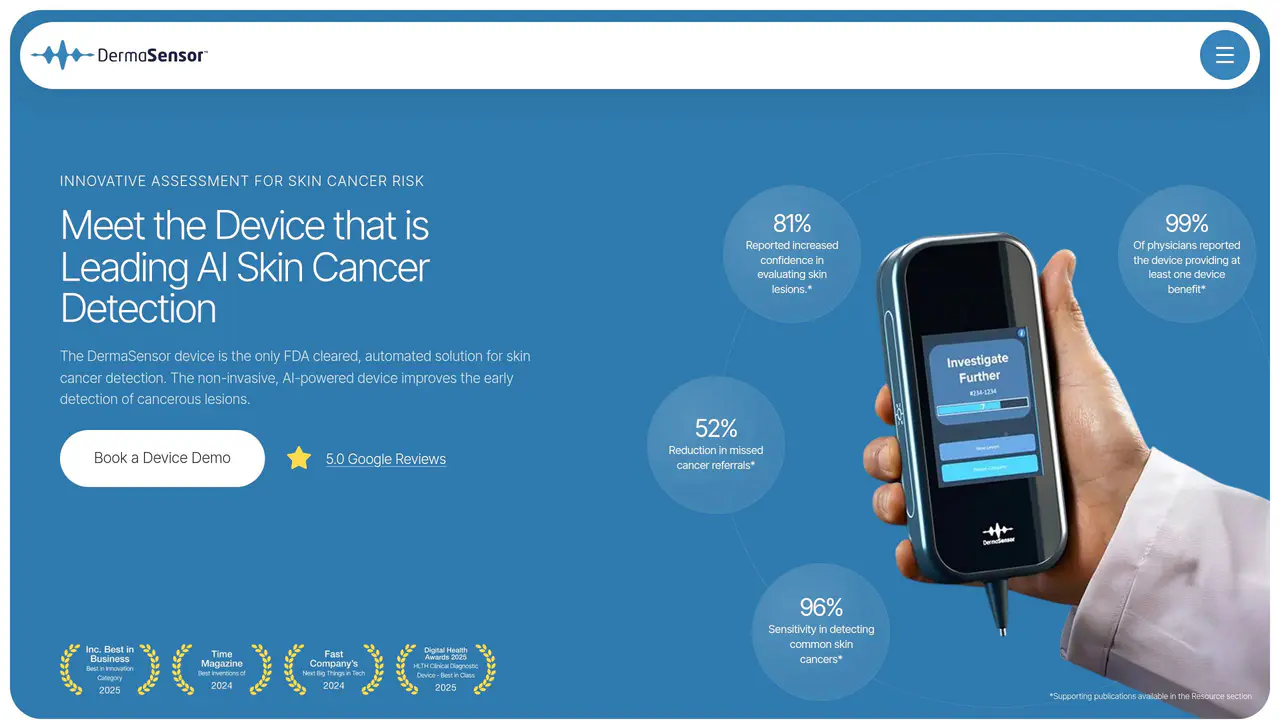
An AI-powered device helping physicians detect skin cancer at the point of care, with 96% sensitivity across all three common skin cancers. Request a demo.
Read-only public captures of DermaSensor’s homepage and verified pricing page. Screenshots are dated, never live embeds, and open full-screen.
Short answers to the questions buyers and builders commonly ask about DermaSensor. Each answer cites the shared ledger below, where every source is listed once.
AI-powered skin cancer risk assessment using Elastic Scattering Spectroscopy (ESS) and a l · AI-powered skin cancer risk assessment with 96% sensitivity across all three common skin c · Uses Elastic Scattering Spectroscopy via a hand-held, point-of-care device to evaluate ski · AI-powered skin cancer detection device for primary care providers
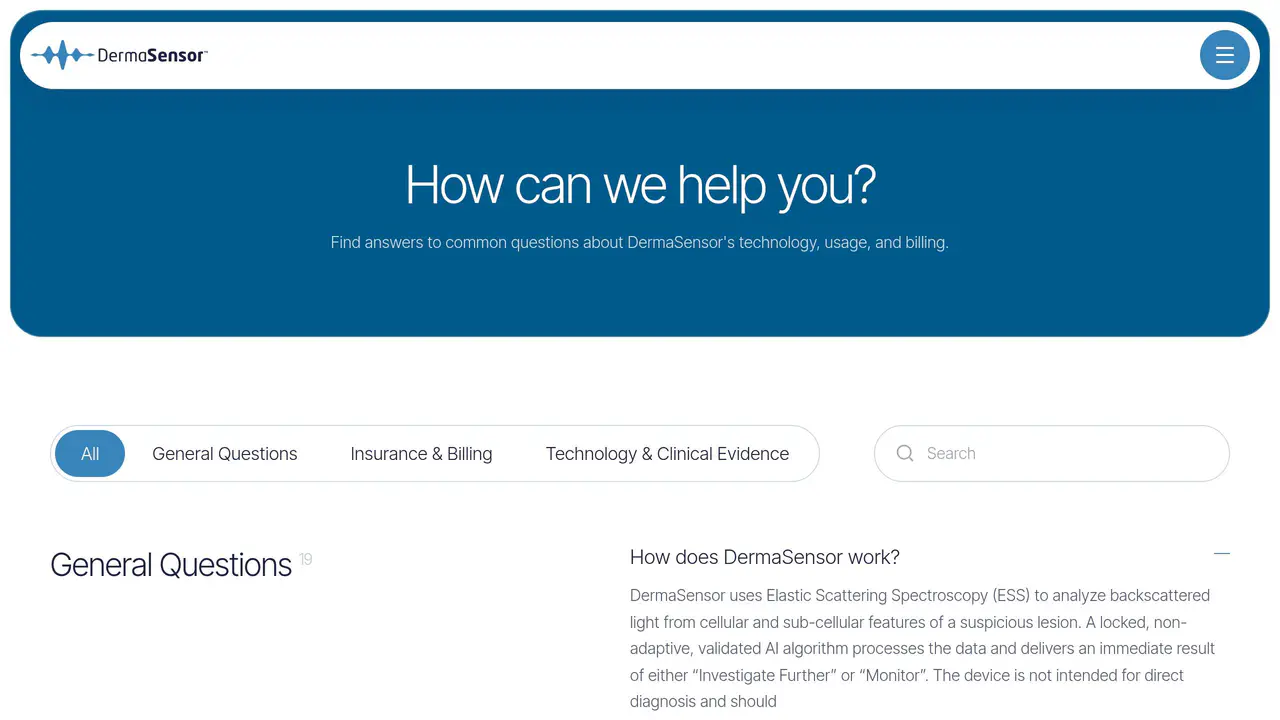
The DermaSensor device uses a combination of Elastic Scattering Spectroscopy (ESS) and artificial intelligence to promptly analyze suspicious skin lesions suggestive of cancer.
Non-dermatologist physicians including family medicine, internal medicine, community healt · Primary care physicians (PCPs) and their practices · Primary care physicians
DermaSensor is indicated for use by physicians who evaluate suspicious skin lesions, including family medicine physicians, internal medicine physicians, and community health physicians.
Point-of-care adjunctive skin cancer risk assessment for suspicious lesions during routine · Adjunctive diagnostic device to help primary care physicians decide which skin lesions sus · Innovative assessment for skin cancer risk
A locked, non-adaptive, validated AI algorithm processes the data and delivers an immediate result of either “Investigate Further” or “Monitor”.
Not intended for direct diagnosis, screening, consumer/at-home use, or as the sole diagnos
The device should not be used as the sole diagnostic criterion nor to confirm clinical diagnosis of skin cancer. It is not intended for consumer or at-home use.
Available on a monthly rental basis with multiple monthly rental packages based on anticip
We have purposely designed our device to be both affordable and accessible to the greatest number of physicians by making it available on a monthly rental basis, so you avoid the expense of an upfront capital cost while being able to choose from different monthly rental packages based on your anticipated use of the proprietary device and FDA cleared algorithm.
EHR integration via uploaded DermaSensor report PDFs, typed 0-10 result and unique device · Partnership with TRG (The Reimbursement Group) for reimbursement support
Most commonly, an electronic version of the DermaSensor report is uploaded to the patient’s record in the EHR. Alternatively, clinicians document the device use and result by simply typing in two things to the EHR for the given patient; the 0-10 device result and the unique device record number provided for each lesion.
This profile connects the jobs DermaSensor is described as handling with its delivery model, access options and the subjects used to match it to related products in this directory.
Each fact points to a recorded source, making it easy to distinguish verified product information from claims that need checking.
HTTP 200 verified twice
AI Skin Cancer Detection & Melanoma Detection | DermaSensor
FDA-cleared Class II medical device (Skin Lesion Analyzer) · Uses Elastic Scattering Spectroscopy (ESS) and locked, non-adaptive AI algorithm · 96% sensitivity across all three common skin cancers (melanoma, BCC, SCC)
AI-powered skin cancer risk assessment using Elastic Scattering Spectroscopy (ESS) and a locked, non-adaptive AI algorithm to analyze suspicious lesions for melanoma, basal cell carcinoma, and squamous cell carcinoma
Point-of-care adjunctive skin cancer risk assessment for suspicious lesions during routine patient visits, delivering immediate 'Investigate Further' (1-10 score) or 'Monitor' outputs
Non-dermatologist physicians including family medicine, internal medicine, community health, and concierge physicians in primary care, health systems, specialty care, and value-based care practices
FDA-cleared Class II handheld medical device (Skin Lesion Analyzer) used as a software-aided adjunctive diagnostic tool, not for direct diagnosis or consumer/at-home use
Handheld physical device with cloud storage for device results and remote device monitoring by DermaSensor
Available on a monthly rental basis with multiple monthly rental packages based on anticipated use; no published outright purchase price
Designed for consistent point-of-care deployment across multi-site clinical environments including family medicine, concierge practices, health systems, community health and worksite clinics
Not intended for direct diagnosis, screening, consumer/at-home use, or as the sole diagnostic criterion; algorithm is locked and not adaptive; does not differentiate between melanoma, basal cell carcinoma, and squamous cell carcinoma
A concise view of the jobs, capabilities and integrations described in the recorded product sources.
Documented product formats, platforms and official distribution destinations. Availability can vary by region and plan.
A concise history of software releases and material product changes. Events appear only when a dated source supports what changed.
Showing the newest updates and meaningful milestones. Open an entry for its summary and source.
DermaSensor announced a new publication demonstrating the high performance of its AI-powered spectroscopy device when evaluating patients' worrisome moles.
View source [5]The Florida State University Family Medicine Residency Program at BayCare Health System integrated DermaSensor into its resident training curriculum.
View source [5]DermaSensor began rolling out its device in Texas as the first automated solution for detecting all three common skin cancers.
View source [5]DermaSensor began its Texas rollout as the first automated device for detecting all three common skin cancers.
View source [5]DermaSensor began its Illinois rollout in Chicago as the first automated device for detecting all three common skin cancers.
View source [5]Facts, answers, structured details, milestones and primary resource links cite this shared ledger. Each external page appears once; release tags from the same GitHub project are grouped under one release history.
These tools share a workflow, capability or audience with DermaSensor. They may complement it rather than replace it, and are not presented as integrations or endorsements.
EHR integration via uploaded DermaSensor report PDFs, typed 0-10 result and unique device record number, dotphrases/smartphrases, or EHR photo apps of the result screen
Customer support available Monday-Friday 8:00am-6:00pm ET via email (support@dermasensor.com) and phone (855.373.6767); onboarding and training included with subscription; no certification required
96% sensitivity for evaluating skin cancer risk across all three common skin cancers (96% sensitivity for melanoma in the dermatology validation study); PCP sensitivity increased from 80.5-82.0% without device to 86.3-91.4% with device
FDA cleared in 2024 following a one-year interactive review of six clinical studies and two non-clinical studies; pivotal validation included 1,579 lesions biopsied by primary care physicians
DermaSensor, Inc.
Delaware corporation
Hand-held, non-invasive, point-of-care skin cancer adjunctive diagnostic device with companion apps and customer portal integrations
AI-powered skin cancer risk assessment with 96% sensitivity across all three common skin cancers
Uses Elastic Scattering Spectroscopy via a hand-held, point-of-care device to evaluate skin lesions
Adjunctive diagnostic device to help primary care physicians decide which skin lesions suspicious for cancer need further evaluation versus monitoring
Primary care physicians (PCPs) and their practices
Point-of-care device deployed in primary care clinics
DERM-SUCCESS FDA Pivotal Study: 95.5% sensitivity, 96.6% NPV, PPV up to 61%; enrolled 1,005 patients with 1,579 lesions across 22 primary care sites in the US (18) and Australia (4)
FDA Pivotal Study completed and Class IIb CE Mark obtained, with NHS collaboration for global expansion
Secured $16M to scale AI-powered skin cancer detection in primary care
Customer portal provides patient materials, marketing assets, Instructions for Use, Reference Guide, DermaSensor Academy video tutorials, and order fulfillment
DermaSensor Academy is an online training platform for customers to learn device use and clinical integration
AI-powered skin cancer detection device for primary care providers
96% sensitivity reported in FDA pivotal studies
Secured $16M to scale AI-powered skin cancer detection in primary care
Partnership with TRG (The Reimbursement Group) for reimbursement support
Reimbursement Hotline at 1-888-298-8848 (Monday–Friday, 8:00am–8:00pm ET) or reimbursement@dermasensor.com
Recognized in TIME's List of the Best Inventions of 2024
AI skin cancer detection and melanoma detection
Innovative assessment for skin cancer risk
Primary care physicians
Medical device (DermaSensor hardware device)
NHS collaboration in the UK as the start of global expansion
Class IIb CE Mark (European regulatory clearance)