HTTP 200 verified twice
A
Workflow tools · Tool
Automatisch
ResearchedAutomatisch is an open-source, no-code workflow automation platform by AB Software GmbH that connects services like Slack and Twitter to automate business processes. It supports cloud or self-hosted deployment via Docker Compose or Render, appealing to GDPR-conscious organizations.
Official site snapshots
Visit live site See the official site at a glance
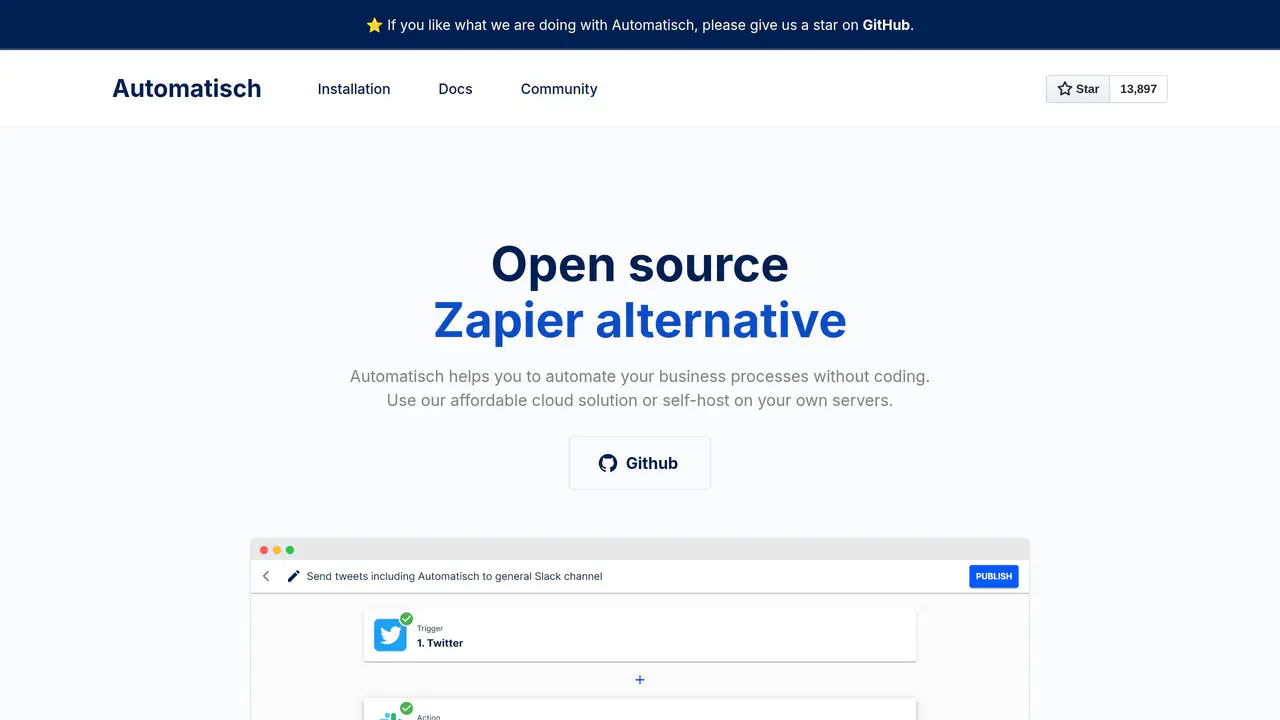
Read-only public captures of Automatisch’s homepage. Screenshots are dated, never live embeds, and open full-screen.
1 earlier capture
In one minute
Start here for the decision-making essentials: what Automatisch does, who it is for, how it is accessed, and the first-party sources behind this profile.
PricingCurrent signal
See official pricing
Platforms
Web
API accessNot public
FoundedNot disclosed by source
AvailabilityWeb / remote
LicenseProprietary
Best suited to
Source-backed fit Businesses seeking a no-code Zapier alternative Healthcare and finance organizations handling sensitive data European companies needing GDPR compliance Teams wanting self-hosted workflow automation Developers contributing to an AGPL-3.0 open-source project Particularly relevant for businesses in healthcare and finance, and for…
Decision support
6 sourced answersCommon questions and adoption checks
Short answers to the questions buyers and builders commonly ask about Automatisch. Each answer cites the shared ledger below, where every source is listed once.
01What does Automatisch say it can do?
No-code workflow automation · Automatisch is a business automation tool that connects different services (e.g., Twitter, · No-code workflow building · No-code workflow automation platform
Build workflow automation without spending time and money. No code is required.
02Who is Automatisch intended for?
Particularly relevant for businesses in healthcare and finance, and for European companies
This is especially relevant for industries such as healthcare and finance, as well as for European companies that must adhere to the General Data Protection Regulation (GDPR).
Ledger citation[2] automatisch.io/docs
03What use cases does Automatisch describe?
Automating business processes without coding · Example workflow: search tweets containing a keyword and post them into a specified Slack · Workflow automation as an alternative to Zapier · Building workflow automation without writing code
Automatisch helps you to automate your business processes without coding.
04What should teams verify before adopting Automatisch?
Workflows currently run at intervals of 15 minutes (instant updates are not yet supported) · Changing the ENCRYPTION_KEY or WEBHOOK_SECRET_KEY environment variables will break existin
Currently, workflows run at intervals of 15 minutes, but we're planning to extend this behavior and support instant updates if it's available with the third-party service.
05What integrations does Automatisch document?
Integrates with widely used online services · Supports integrations including Slack, GitHub, GitLab, Gmail, Google Calendar, Google Docs · Supports third-party apps with a request integration option · Supports integrations (called apps) with third-party services using triggers and actions
We integrate with the most widely used online services in the market so you can grow your business by building workflows.
06How can Automatisch be deployed or accessed?
Cloud and self-hosted · Automatisch can be self-hosted so that users keep their data on their own servers. · Docker Compose installation supported · Docker installation with two services (main and worker) on the same image
Use our affordable cloud solution or self-host on your own servers.
Decision guide
Workflow toolsCapabilities and operating fit
This profile connects the jobs Automatisch is described as handling with its delivery model, access options and the subjects used to match it to related products in this directory.
Common use cases
- Automating business processes without coding
- Connecting third-party services like Twitter, Slack, GitHub, and Stripe
- Searching tweets containing a keyword and posting them to a Slack channel
- Self-hosting workflows to store data on own servers
- Deploying via Docker Compose or Render with PostgreSQL and Redis backend
- Example workflow: search tweets containing a keyword and post them into a specified Slack
Topics mapped
Verified capabilities
- No-code workflow automation
- Automatisch is a business automation tool that connects different services (e.g., Twitter,
- No-code workflow building
- No-code workflow automation platform
- Build workflow automation without spending time and money; no code is required.
- Workflow automation without coding required
- Workflows consist of triggers as starting points and actions as subsequent steps that proc
Recorded integrations
Intended audiences
Access signals
- Pricing model
- See official pricing
- API
- Not publicly listed
- Source links
- 8 recorded
Source-backed
Updated July 22, 2026Verified facts
Each fact points to a recorded source, making it easy to distinguish verified product information from claims that need checking.
Automatisch - Open Source Zapier Alternative
No-code workflow automation capability · Open source project licensed under AGPL-3.0 · Cloud and self-hosted deployment options
No-code workflow automation
Automating business processes without coding
Cloud and self-hosted
true
Self-hosting allows storing data on own servers
View 32 more verified facts
Integrates with widely used online services
Automatisch is a business automation tool that connects different services (e.g., Twitter, Slack) to automate business processes, requiring no programming knowledge.
Example workflow: search tweets containing a keyword and post them into a specified Slack channel.
Automatisch can be self-hosted so that users keep their data on their own servers.
Particularly relevant for businesses in healthcare and finance, and for European companies that must comply with GDPR, as well as any organization handling sensitive user data.
Workflows currently run at intervals of 15 minutes (instant updates are not yet supported).
Open source
Workflow automation as an alternative to Zapier
No-code workflow building
AB Software GmbH
GDPR-compliant personal data processing
No-code workflow automation
Open source project hosted on GitHub
Docker Compose installation supported
Docker installation with two services (main and worker) on the same image
Render deployment supported via render.yaml file
Third-party service credentials encrypted using ENCRYPTION_KEY environment variable
Building workflow automation without writing code
No-code workflow automation platform
Supports integrations including Slack, GitHub, GitLab, Gmail, Google Calendar, Google Docs, Google Drive, Google Forms, Google Sheets, Google Tasks, HubSpot, Stripe, Salesforce, Trello, Twilio, Twitter, WordPress, YouTube, Zendesk, Notion,
Automatisch (copyright 2022)
Project has a public GitHub repository
Build workflow automation without spending time and money; no code is required.
Deployed via Docker Compose by modifying docker-compose.yml environment variables for both main and worker services.
Uses ENCRYPTION_KEY to store third-party service credentials and WEBHOOK_SECRET_KEY to verify webhook requests.
Runs as a web application on HTTP port 3000 by default, backed by PostgreSQL and Redis services.
Changing the ENCRYPTION_KEY or WEBHOOK_SECRET_KEY environment variables will break existing connections and flows.
Workflow automation without coding required
AGPL-3.0 license
Automatisch
Code hosted and developed on GitHub
Supports third-party apps with a request integration option
Practical capabilities
8 documented areasWhat it helps with
A concise view of the jobs, capabilities and integrations described in the recorded product sources.
Automating business processes without coding
Connecting third-party services like Twitter, Slack, GitHub, and Stripe
Searching tweets containing a keyword and posting them to a Slack channel
Self-hosting workflows to store data on own servers
Deploying via Docker Compose or Render with PostgreSQL and Redis backend
Example workflow: search tweets containing a keyword and post them into a specified Slack
Workflow automation as an alternative to Zapier
Building workflow automation without writing code
Availability
Source checkedWhere it runs and where to get it
Documented product formats, platforms and official distribution destinations. Availability can vary by region and plan.
Cost / license
See official pricingtrue · Open source · Open source project hosted on GitHub
Platforms
Runs as a web application on HTTP port 3000 by default, backed by PostgreSQL and Redis serCode hosted and developed on GitHubApps are defined via an index.js entry point listing triggers, actions, and data sources
Adoption notes
DeploymentCloud and self-hosted · Automatisch can be self-hosted so that users keep their data on their own servers. · Docker Compose installation supported · Docker installation with two services (main and worker) on the same image
Licensetrue · Open source · Open source project hosted on GitHub
Model supportNot disclosed by source
Data controlSelf-hosting allows storing data on own servers · GDPR-compliant personal data processing · Third-party service credentials encrypted using ENCRYPTION_KEY environment variable · Uses ENCRYPTION_KEY to store third-party service credentials and WEBHOOK_SECRET_KEY to ver · User credentials for third-party services are encrypted and stored in the database
Learning curveIntermediate
Primary use casesAutomating business processes without coding, Connecting third-party services like Twitter, Slack, GitHub, and Stripe, Searching tweets containing a keyword and posting them to a Slack channel, Self-hosting workflows to store data on own servers, Deploying via Docker Compose or Render with PostgreSQL and Redis backend, Example workflow: search tweets containing a keyword and post them into a specified Slack, Workflow automation as an alternative to Zapier, Building workflow automation without writing code, Build workflow automation without code, including integrations between third-party service
What to verify before adopting
- Workflows currently run at intervals of 15 minutes (instant updates are not yet supported)
- Changing the ENCRYPTION_KEY or WEBHOOK_SECRET_KEY environment variables will break existin
Evolution and major updates
Research in progressAutomatisch timeline
A concise history of software releases and material product changes. Events appear only when a dated source supports what changed.
Scheduled for research
Building a reliable release history.
This profile is being checked for dated releases and material product changes. Nothing appears here until the exact date and event can be verified from a recorded source.
Dated event Short explanation Original source
Citation ledger
8 unique pagesRecorded sources
Facts, answers, structured details, milestones and primary resource links cite this shared ledger. Each external page appears once; release tags from the same GitHub project are grouped under one release history.
- 1automatisch.io 11 facts · 4 answers · Official site
- 2automatisch.io/docs 5 facts · 5 answers · Documentation
- 3automatisch.io/docs/guide/installation 6 facts · 2 answers · Documentation
- 4automatisch.io/docs/advanced/configuration 5 facts · 2 answers · Documentation
- 5automatisch.io/docs/build-integrations/folder-structure 6 facts · 1 answer · Documentation
- 6automatisch.io/docs/guide/available-apps 5 facts · 2 answers · Documentation
- 7automatisch.io/privacy 5 facts · 2 answers · Security
- 8automatisch.io/docs/contributing/contribution-guide 5 facts · 1 answer · Documentation
Research status46 substantive facts · 8 source pages · quality score 88/100
Connected directory
Semantic matchesExplore related solutions
These tools share a workflow, capability or audience with Automatisch. They may complement it rather than replace it, and are not presented as integrations or endorsements.