HTTP 200 verified twice
Finding your next stop…
Loading the latest directory information.
Loading the latest directory information.
AI Safety Camp is a virtual research incubator that helps participants team up on concrete AI safety projects. It runs team-based programs with mentorship, weekly meetings, and produces open-source code, papers, and policy outputs.
Start here for the decision-making essentials: what AI Safety Camp does, who it is for, how it is accessed, and the first-party sources behind this profile.
See official pricing
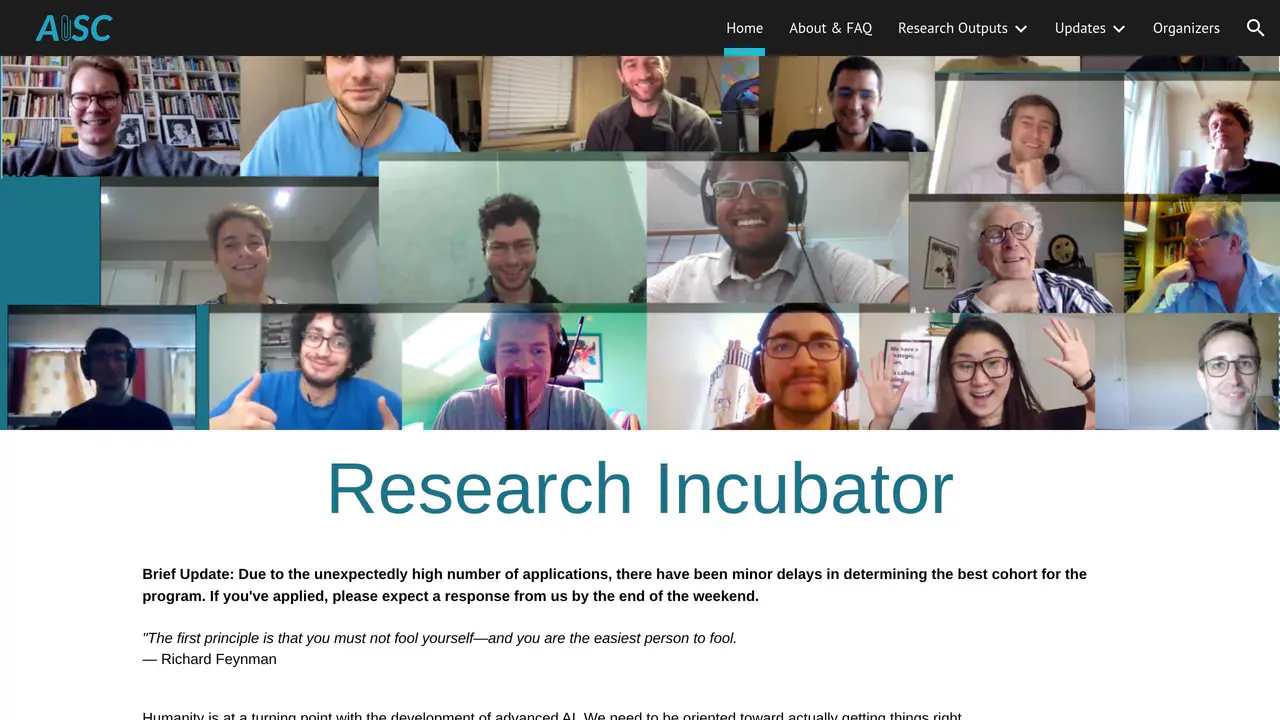
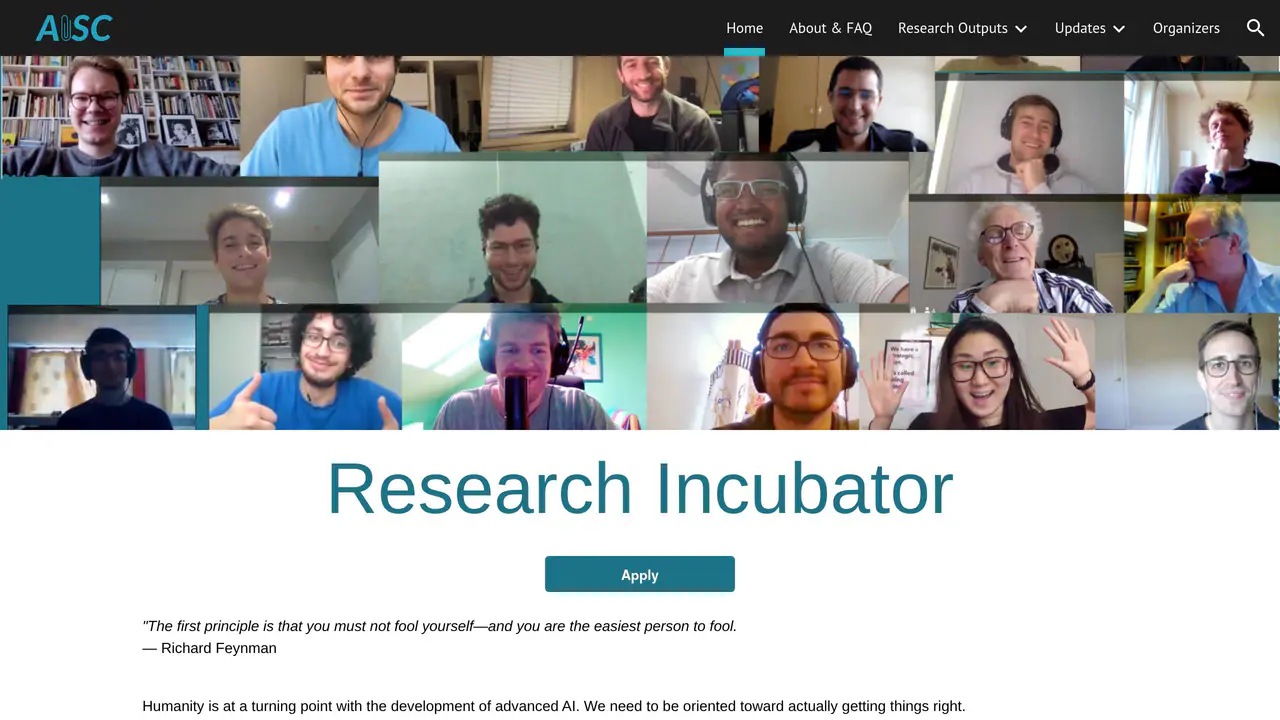
Read-only public captures of AI Safety Camp’s homepage. Screenshots are dated, never live embeds, and open full-screen.
Short answers to the questions buyers and builders commonly ask about AI Safety Camp. Each answer cites the shared ledger below, where every source is listed once.
Provides structured program with weekly team meetings, organizer one-on-ones, lightning ta · Camp projects produce peer-reviewed papers (e.g., presented at the AI Safety Workshop at I · Produces diverse research output types including academic papers, tabletop games, software · Each camp edition involves 6 teams collaborating on AI safety research projects
We require that every team have weekly team meetings, and that participants spend a minimum of 10h/week working on the project.
Students, engineers, independent researchers, people from policy or community building, or · Participants include named research leads (e.g., Jeremy Gillen, Robert Kralisch, Nicholas · Designed for both AI safety newcomers entering the field and established researchers, with · AI safety researchers and research-oriented participants, including team members and exter
You might be a student, an engineer, an independent researcher, someone from policy or community building, or something else entirely.
Helping people who want to work on AI Safety to team up together on concrete projects · Research projects spanning AI alignment, AGI safety, machine learning safety, memetics, an · AI safety research including mechanistic interpretability, AI control, alignment, AI polic
We help people who want to work on AI Safety to team up together on concrete projects.
Requires at least 10 hours per week for 3 months (mid January to mid April) for project le
We ask all participants (including research leads) to commit at least 10h per week for 3 months (mid January to mid April).
Virtual, hosted on Zoom · Camps delivered both in-person and virtually; virtual format used since 2020 due to COVID-
Format: Virtual (Zoom).
Participants receive mentorship from external collaborators drawn from the AI safety resea
External collaborators: Beth Barnes (mentor)
This profile connects the jobs AI Safety Camp is described as handling with its delivery model, access options and the subjects used to match it to related products in this directory.
Each fact points to a recorded source, making it easy to distinguish verified product information from claims that need checking.
HTTP 200 verified twice
Home
AI Safety research incubator · Organized by Remmelt and Robert · Helps people team up on AI safety projects
AI Safety research incubator
AI Safety Camp, organized by Remmelt and Robert
Helping people who want to work on AI Safety to team up together on concrete projects
Ensuring future AI systems are both developed and deployed in robustly safe ways and preventing uncontrollably unsafe AI from being developed
16-day virtual incubator scheduled 15th – 30th August 2026
Virtual, hosted on Zoom
Entirely online, open to participants in all time-zones; weekend sessions grouped into Americas, Europe-Africa, and Asia-Pacific with one all-hands session at best overlap time
Students, engineers, independent researchers, people from policy or community building, or any role with own confusions about how to keep AI safe
Participants join either as a project lead (propose and lead a project) or as a team member (join an accepted project)
A concise view of the jobs, capabilities and integrations described in the recorded product sources.
Documented product formats, platforms and official distribution destinations. Availability can vary by region and plan.
A concise history of software releases and material product changes. Events appear only when a dated source supports what changed.
This profile is being checked for dated releases and material product changes. Nothing appears here until the exact date and event can be verified from a recorded source.
Facts, answers, structured details, milestones and primary resource links cite this shared ledger. Each external page appears once; release tags from the same GitHub project are grouped under one release history.
These tools share a workflow, capability or audience with AI Safety Camp. They may complement it rather than replace it, and are not presented as integrations or endorsements.
Provides structured program with weekly team meetings, organizer one-on-ones, lightning talks, and feedback
Requires at least 10 hours per week for 3 months (mid January to mid April) for project leads and team members
2018 — first camp held in Las Palmas (AISC1 2018, AISC2 Prague 2018, AISC3 Madrid 2019)
Team-based collaborative AI safety research camp where participants work in small groups on assigned projects during each edition.
First AI Safety Camp (AISC1) took place in Las Palmas in 2018.
AI Safety Camp runs both in-person and fully virtual editions, with virtual editions beginning in 2020 (AISC4).
Multiple camp projects release code publicly on GitHub, including the Agent TensorBoard plugin, the IRL benchmark framework, the safe-grid-agents repository, the GameGym library, and the Delphi small-LM training suite.
Camp projects produce peer-reviewed papers (e.g., presented at the AI Safety Workshop at IJCAI 2019), blog posts, open-source libraries, and policy papers.
Project outputs are also distributed as installable packages on PyPI, such as the mechanistic-interpretability Patchscopes implementation.
Camp teams have applied for continuation grants from the Effective Altruism Foundation (e.g., a $5,000 grant request after AISC2 for the AI Safety for Kids project).
Team communication and updates happen over Slack, dedicated Discord channels (e.g., a Mech Interp Discord), LessWrong posts, and email; participants and organizers also link to GitHub repositories for code.
AI Safety Camp is an AI safety research training program that organizes team-based research projects led by research leads
Research outputs are published on LessWrong and Arxiv
Participants include named research leads (e.g., Jeremy Gillen, Robert Kralisch, Nicholas Kees Dupuis, Paul Bricman, Jacob Pfau, Eleanor 'Nell' Watson, En Qi Teo), team participants, and external collaborators working on AI safety
Team-based research camp with external mentors, producing research outputs on AI safety topics
Focused on AI alignment research aimed at ensuring artificial intelligence benefits humans
Research projects spanning AI alignment, AGI safety, machine learning safety, memetics, and meta-ethics for AI governance
Produces diverse research output types including academic papers, tabletop games, software tools, and datasets
Designed for both AI safety newcomers entering the field and established researchers, with team-based projects
Participants receive mentorship from external collaborators drawn from the AI safety research community
Research outputs are published and shared on LessWrong and GitHub, with some work presented at conferences like NeurIPS
Includes AI alignment research survey work that built a classifier to detect relevant alignment research articles
AI Safety Camp
Each camp edition involves 6 teams collaborating on AI safety research projects
AI safety researchers and research-oriented participants, including team members and external research collaborators/mentors
Website hosted on Google Sites
Camps delivered both in-person and virtually; virtual format used since 2020 due to COVID-19
First camp (AISC1) held in Las Palmas in 2018